

ChatGPT optimisation improves a company's website, content and public information so its brand is better placed to be discovered, represented accurately and considered in relevant AI answers. It includes technical access, a clear offer, buyer answers, verifiable sources and business-enquiry measurement.
My first question is: which buyer decision do you want to participate in? Supplier recommendations, solution comparisons and reliability checks need different information. The answer determines pages, content and success criteria.
I believe GEO must connect to sales. Value comes when potential clients understand your offer accurately and have reasons to take the next step. Mention counts belong alongside quality, visits and enquiries your team can turn into business.
This guide explains the whole process: initial checks, content, technical changes, sources, measurement and agency collaboration. Examples are illustrative, not client results.
What does ChatGPT optimisation include?
We make information important to choosing your company accessible, understandable, accurate and supported. That includes your domain and relevant public sources. We then check representation in answers to predefined questions.
A distribution-software company may want to appear for “Which inventory solution suits a distributor with multiple warehouses?” The offer needs supported processes, limitations, integrations and implementation. “Reliable digital solutions” leaves too much unanswered.
Record four outcomes separately:
- Mention: the brand appears in the answer.
- Citation: a page is linked as a source and verified.
- Recommendation: the company is suggested in the context of user needs.
- Enquiry: someone contacts you about the offer.
These can overlap, but one does not prove another. Educational citations are not automatically service recommendations. Negative or incorrect mentions are not wins.
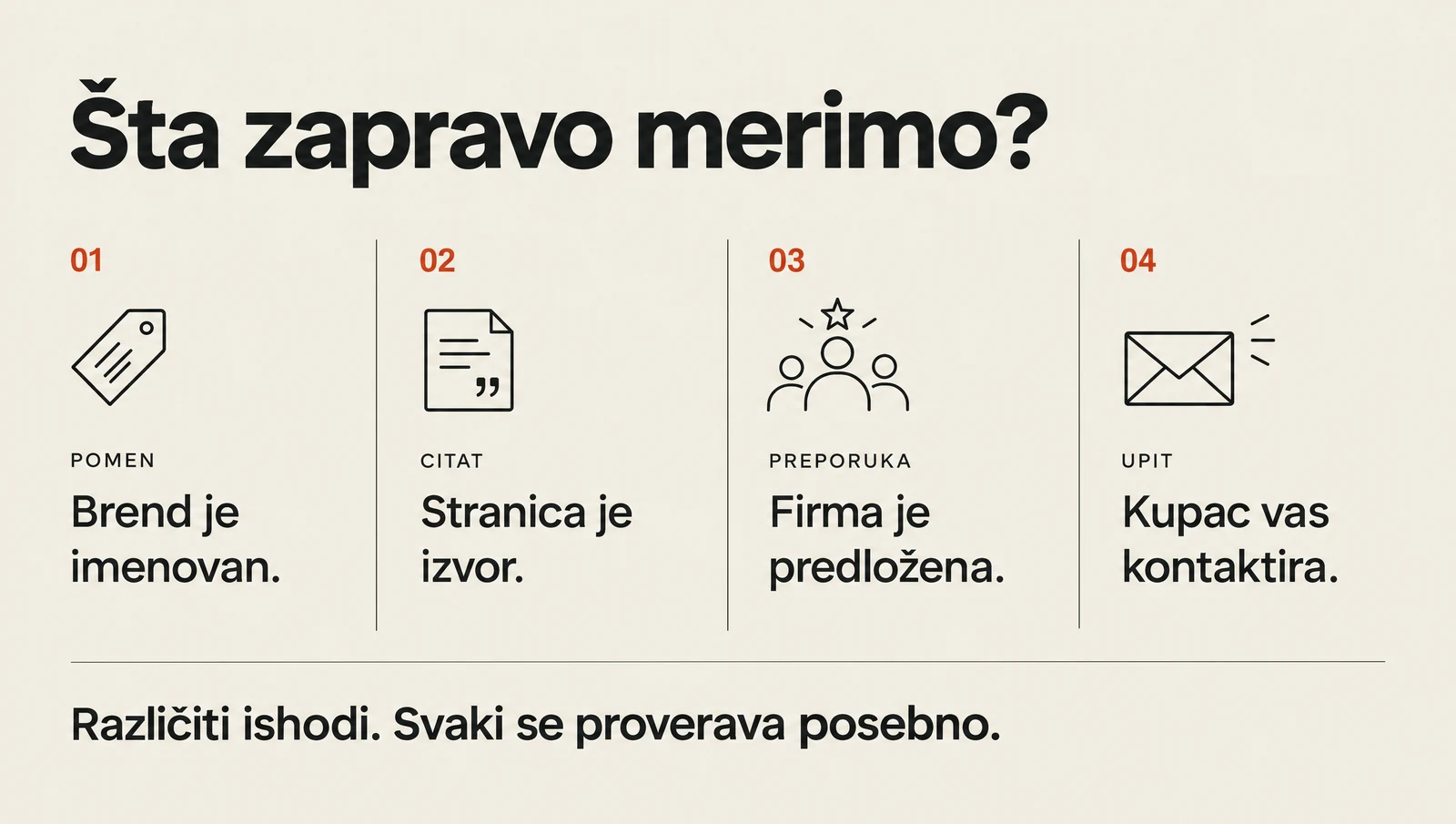
Text description of the graphic
- Mention: the brand is named.
- Citation: a page is used as a source.
- Recommendation: the company is suggested.
- Enquiry: a buyer contacts you.
Why does AI visibility matter to companies?
Companies need to be present where buyers research problems, compare options and shortlist suppliers. When that happens through AI, incomplete offer information becomes a business issue: wrong descriptions, missed advantages or exclusion from consideration.
Focus particularly on long decisions, comparison-heavy products and trust-sensitive services. Strong explanations help buyers and sales. Guides, clear service pages and documentation remain useful to visitors from Google, referrals or direct sources too.
How do I assess priority?
Start with sales and support: which questions precede serious enquiries, what is misunderstood and what supports budget approval? Then check searches and platform answers. Tools provide part of the picture; real questions prevent irrelevant optimisation.
Choose the first topic by proximity to the desired service, importance of the decision and quality of information you can provide. Large volumes alone are insufficient. Narrow topics can be valuable when they attract suitable buyers.
If the offer is unclear, forms fail or sales does not respond, address those early. Visibility is more valuable with a clear contact path. Include conversion optimisation where initial checks justify it.
How does ChatGPT obtain online information?
Search is particularly relevant here. ChatGPT can search the web and show sourced answers, automatically or at the user's request. It may turn a question into multiple targeted queries when using external search services. See the official search explanation.
Content should answer the subquestions behind a decision: compatibility, migration and support for software; location, availability and terms for local services; scope, responsibility and evaluation for consulting.
Assess answers without web search separately. Website edits do not instantly change model knowledge, and publication does not establish training use. Record modes and sources, then open cited pages to see what they actually support.
OpenAI says placement is not guaranteed. No public formula supports promises of first place or permanent recommendations. We can commit to checks, changes, content quality and repeatable reporting.
How do SEO, AEO and GEO connect?
SEO develops organic-search presence. AEO, Answer Engine Optimization, emphasises specific answers. GEO, Generative Engine Optimization, concerns brand information in generated answers. Terms overlap; proposals need scope more precise than acronyms.
| Approach | Work focus | What I check |
|---|---|---|
| SEO | Access, indexing, relevant pages and organic search | Indexed pages, queries, impressions, clicks and conversions |
| AEO | Clear questions, precise answers and understandable structure | Accuracy and the reader's ability to find the next step |
| GEO | Brand, information, sources and AI-answer presence | Mentions, citations, recommendations, context and available business signals |
I recommend shared content and technical planning, with separate reporting where results differ. If you already invest in SEO, first assess what can be extended. See the SEO, AEO and GEO comparison.
Google has its own AI features and rules. Its documentation says no special additional optimisation or mandatory schema is required. Do not transfer one platform's rules automatically to another. See Google AI Overviews and AI Mode.
ChatGPT optimisation in seven steps
A good plan states what we do, why, who owns it and how completion is verified. Adapt this sequence to your offer and starting condition. Some tasks can run together, but each needs a clear output.
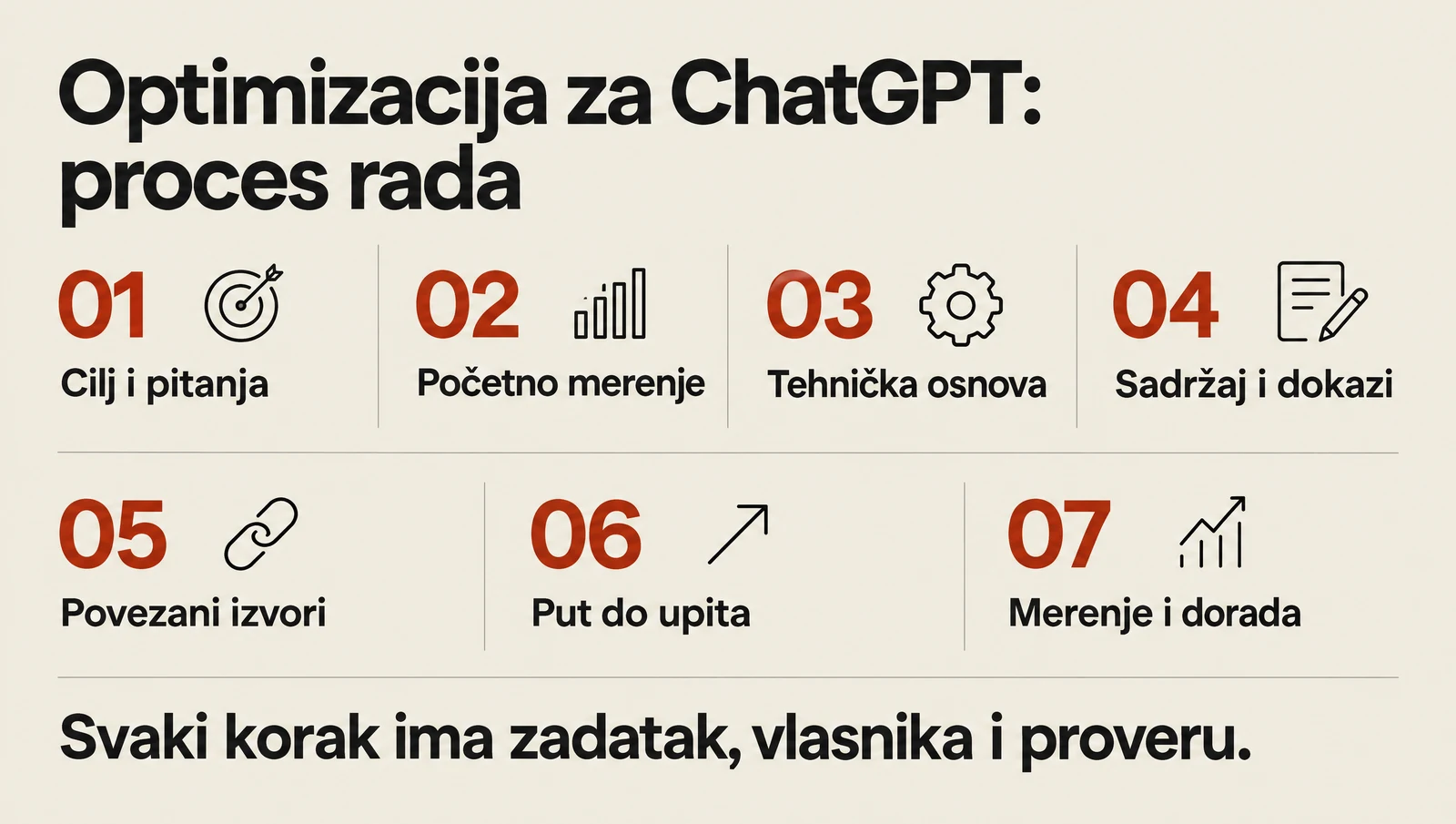
Text description of the graphic
- Goal and buyer questions.
- Baseline measurement.
- Technical foundations.
- Content and evidence.
- Connected sources.
- The enquiry journey.
- Measurement and iteration.
1. Choose business goals and buyer questions
Select an important offer and its audience. Agree on market, language, territory, constraints and desired enquiries. Translate “more AI visibility” into a specific task, such as presence during supplier selection.
Map questions by decision stage using keyword research, sales conversations and relevant results. Ahrefs and DataForSEO estimate Google demand; those volumes are not ChatGPT question counts.
| Intent | Illustrative question | Useful content |
|---|---|---|
| Understanding a problem | Why do inventory figures differ across warehouses? | A guide to causes and checks |
| Comparing approaches | When is the existing ERP enough, and when is WMS needed? | A needs-based comparison |
| Choosing a supplier | How do we choose a WMS implementation partner in Serbia? | Selection criteria, process and expertise evidence |
| Checking a company | Which integrations does this solution support? | Accurate documentation and offer page |
Deliverable: priority questions with intent, related offer and proposed destination. Each topic needs a reason it might attract relevant buyers.
2. Establish an AI visibility baseline
Before major edits, test agreed questions and record date, language, market, search mode and answers. Repeat under similar conditions, documenting differences. Separate branded and unbranded questions.
Start each panel question in a new conversation. Record model, search mode, location, memory and personalisation settings and keep them consistent. OpenAI explains that memory can influence search. Document uncontrollable conditions as limitations.
An initial working sample may contain twenty to thirty questions across intents. This is practical, not representative of all users. Adapt to service complexity; purposeless extra tests merely enlarge reports.
Open cited sources and record useful features: prices, instructions, comparisons, documentation or examples. Treat observed patterns as hypotheses. A citation does not reveal the factor causing selection.
Deliverable: a baseline AI visibility audit with answers, sources, inaccuracies and priorities. Useful findings lead to executable tasks.
3. Check technical website access
Check server responses, main content and access without login, then robots.txt, indexing directives, canonical, links, sitemap and security restrictions. Access challenges require different work from weak copy.
Distinguish OpenAI bots. The official documentation describes OAI-SearchBot for search, GPTBot for possible training collection and ChatGPT-User for certain user-requested visits. Search and training permissions are independent.
ChatGPT-User does not determine Search inclusion. Robots rules may not apply to user-requested visits; this cannot establish search-bot access.
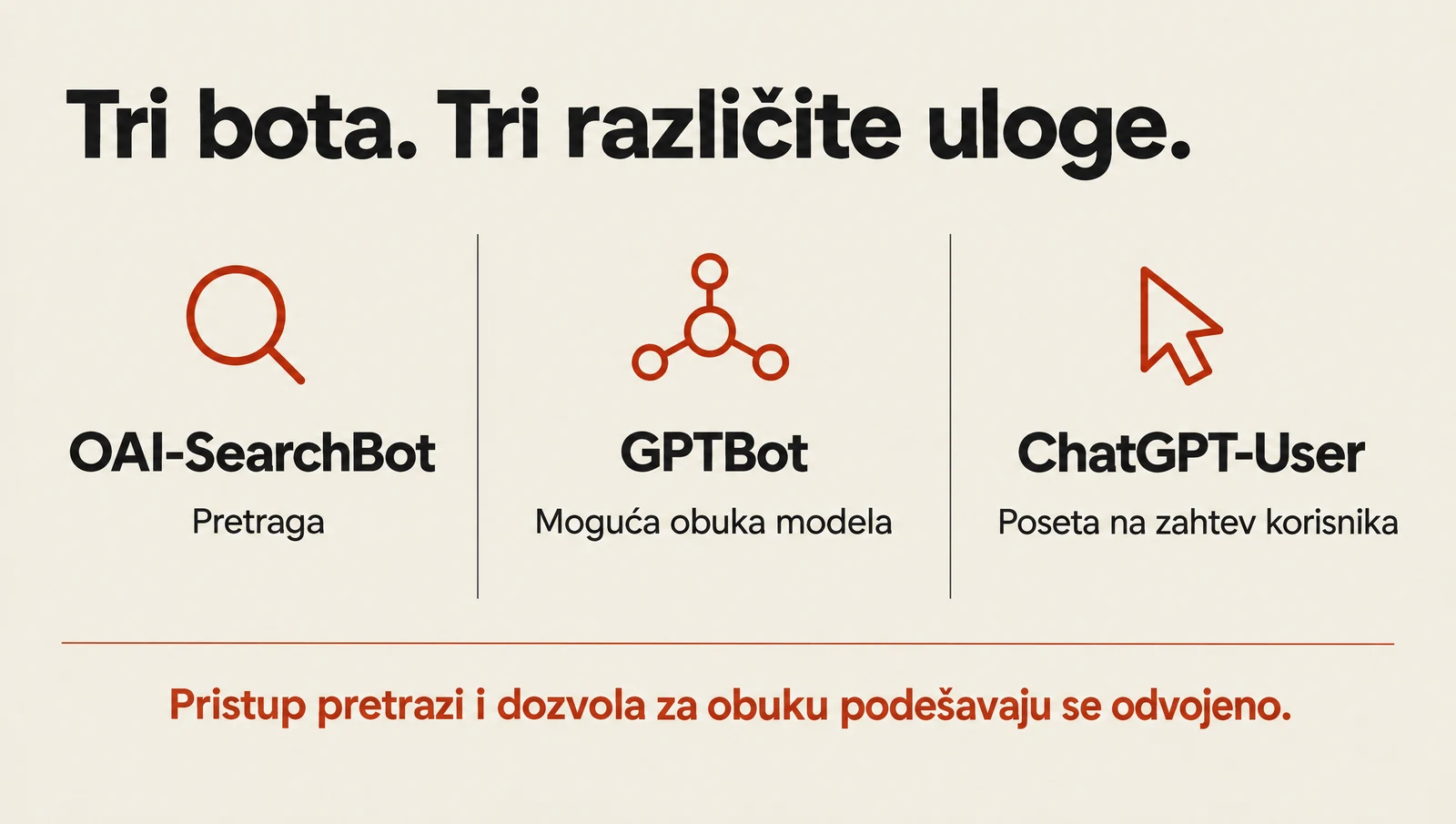
Text description of the graphic
- OAI-SearchBot: search.
- GPTBot: content for possible model training.
- ChatGPT-User: certain user-requested visits.
- Search access and training permission are configured separately.
For a fully public site wishing to allow search and disallow GPTBot, a simplified example is:
User-agent: OAI-SearchBot
Allow: /

User-agent: GPTBot
Disallow: /
Review the entire existing robots.txt first. A specific OAI-SearchBot group does not inherit restrictions from User-agent: *; needed Disallow rules must also appear in the specific group. See the robots.txt group-selection standard. Do not overwrite existing policies with this example. Authentication protects confidential areas; robots.txt is not access control.
After changes, check hosting and CDN responses too. File permissions do not help if another layer blocks access. Verify crawler identity against OpenAI's published IP ranges rather than user-agent names alone. Simulated requests test rules, not proof of a real bot visit.
For public articles and service pages, I recommend initial-HTML content where feasible, reducing script dependence. Verify genuine HTML links and meaningful image alt text.
Deliverable: specific technical findings, owner, priority and repeat checks. “Technical SEO done” is insufficient maintenance documentation.
4. Improve content, offer and evidence
Start nearest sales: services or product categories, then company information, collaboration process and key questions. Blogs support complex concerns. Attracting readers while leaving the offer unclear breaks the journey.
Each important section needs a question or task. Begin with a direct answer, followed by explanation, terms and examples. Headings aid navigation, tables comparisons, graphics relationships and processes, and paragraphs reasoning. Decision-critical information must also exist as readable text.
Demonstrate expertise through explained choices, risks and verification. Approved, documented client results can become case studies; otherwise use clearly labelled illustrations and methods.
For platform claims, prefer official documentation. Product claims need confirmation from responsible teams. Healthcare, finance and sensitive topics need appropriate specialists. Marketing should not promise what the actual service cannot deliver.
Include real authorship, update dates and relevant structured data. Article or BlogPosting can describe authors, headlines, dates and images. Match visible content; schema does not prove future AI recommendations.
Deliverable: a page-change map, drafts, required evidence and accuracy review. Completion means better buyer understanding, not a fixed word count.
5. Connect pages and check public sources
Plan internal links around readers' next questions. Main guides lead to detail; expert articles connect relevant offers and complementary answers. Readers should reach decisions without searching the entire site.
Link descriptions should explain destinations. “How we measure AI visibility” is better than repeated “click here”. See Google's link guidance. Avoid forcing the same phrase into every link.
Review business profiles, directories, partner pages and specialist publications for inaccuracies, outdated descriptions and useful information opportunities. Expert contributions need an actual audience and editorial reason.
Exclude purchased statements, fake reviews and mass forum links. Reputation requires real information and relationships. No individual publication guarantees ChatGPT use.
Deliverable: internal-link map and public-source actions: correct data, expand a profile or prepare a useful contribution. Each needs a buyer-related rationale.
6. Improve the visit-to-enquiry journey
Sales content should explain what visitors get, what happens after contact and how demanding the step is. Complex services may suit introductory calls or audit discussions; products may need comparisons, availability checks or purchase.
Place CTAs where readers have enough context. Buttons should be legible on phones, separate from long prose and connected to specific destinations. Forms need only purposeful information.
Check submission, confirmation, receipt and sales handling. Agree on qualified enquiries: service, market, need and fit. More forms without definitions can misrepresent progress.
Deliverable: a clear CTA, verified contact journey and enquiry records. See landing pages leading to enquiries.
7. Repeat measurement and choose further changes
Repeat agreed checks after implementation and compare the baseline. Log dates, URLs, changes and reasons for significant edits.
Reports show answer presence, accuracy, traffic-driving pages and enquiry quality. Variation remains visible. If content, offers and ads change together, do not attribute every contact solely to GEO.
Deliverable: observed changes, limitations and next priorities. The report should support next month's decisions: continue, improve or stop unjustified work.
What does a page worth optimising look like?
Imagine a software implementer whose homepage says “Innovative solutions for business growth”. It explains neither problem, buyer nor scope. First collect actual team answers, then write a specific offer.
An illustrative description: “We implement inventory tracking across your warehouses, checking integration with your ERP. Before proposing work, we map locations, goods flows and exchanged data.” Publish such statements only if true.

Text description of the graphic
- What you offer.
- Whom it suits.
- How you work.
- What supports claims.
- Terms and limitations.
- The next step.
Develop the page through six sections:
- Offer: the service and problem solved.
- Suitability: company type, need and limitations.
- Process: stages, client duties and deliverables.
- Evidence: documentation, approved examples, specialists and references.
- Terms: scope, timing, pricing factors and exclusions.
- Next step: conversation, demo or proposal request.
Supporting articles should address questions too detailed for the service page: migration, integration risks and selection criteria. Give each a purpose. Ten similar articles make the main page harder to identify.
See a narrower checklist in company information for AI search. This main guide explains the process; that guide applies it to specific information.
For stores, see AI shopping: products, sellers and the order journey, including catalogues, feeds and a work plan.
What differs by industry?
The basic process is similar, but content follows actual buyer decisions. Do not copy the same panel across healthcare, software and retail. These possible directions need validation for the actual business.
| Industry | What buyers need to understand | First checks |
|---|---|---|
| B2B and SaaS | Use, integrations, implementation and support | Use-case pages and documentation |
| Ecommerce | Product differences and purchase terms | Specifications, categories, availability and delivery |
| Healthcare | Services and booking | Accurate information, qualifications and specialist claim review |
| Finance | Terms, costs and limitations | Offer precision, currency and expert review |
| Real estate | Location, features and offer status | Current data and clear contact |
| Travel | Facilities, location and booking terms | Accuracy and cross-channel consistency |
| Education | Programme suitability and content | Prerequisites, plan, instructors and applications |
Location-dependent companies need accurate addresses, hours and service areas. Connect this with local SEO and Google Business Profile, checking each platform's rules separately.
For multiple languages, each offer must reflect its market's terms. Translation is a start: verify actual service availability, delivery responsibility and contact process.
How would I organise the first 90 days?
Establish foundations, implement priorities and make initial comparisons. Adapt this example to website scope and resources. It is not a ranking, citation or client-count guarantee.
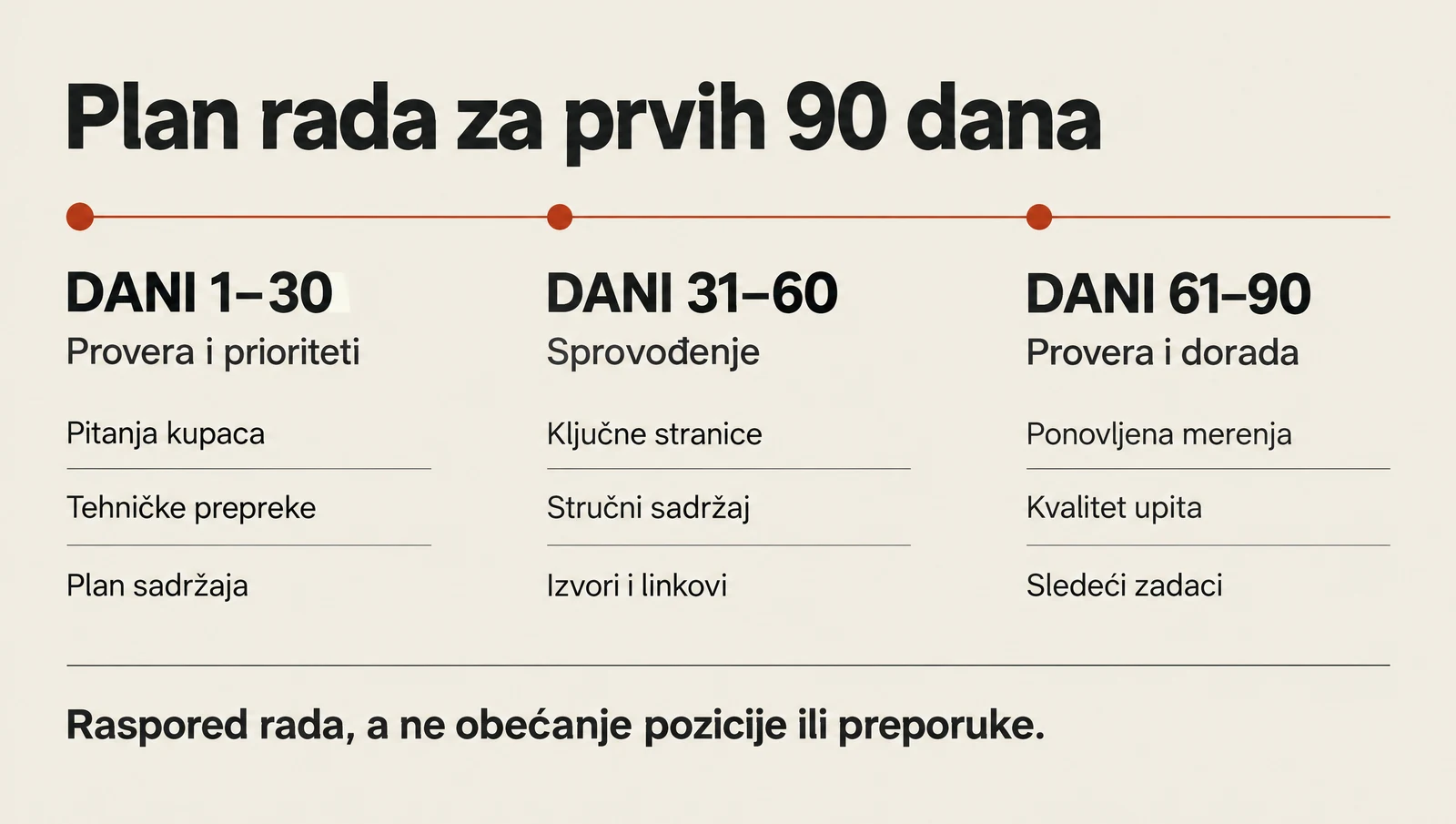
Text description of the graphic
- Days 1–30: buyer questions, technical obstacles and content planning.
- Days 31–60: key pages, expert content, sources and links.
- Days 61–90: repeated measurements, enquiry quality and next tasks.
First 30 days: diagnosis and decisions
Agree on goals, questions, measures and access. Establish the baseline, review key pages and separate technical obstacles from missing information. Choose initial changes and assign specialists, implementation and verification.
Deliver a usable document: priority, URL, task, output, owner and criteria. “Insufficient authority” must become documented specific problems.
Days 31–60: implementation
Improve key pages, prepare content and explanatory graphics and connect pages. Verify technical changes before publication. Correct public sources through proper procedures. Check URLs, metadata, links, mobile layouts and sitemaps with publication.
Prioritise clear obstacles: blocked access before decoration, inaccurate service descriptions before repetitive articles. The rationale should be understandable outside the SEO team.
Days 61–90: comparison and iteration
Repeat measurements, review visits and discuss contacts with sales. Identify remaining concerns and inaccuracies, then define the next content and implementation cycle.
Sygnific's GEO and AI visibility page describes longer engagements with monthly measurement. This schedule covers the beginning. Final scope and timing follow site and resource reviews.
How do you measure value?
Track page access, AI answers, website visits and qualified enquiries. Each answers a different question; together they are more useful than one aggregate “AI score”.
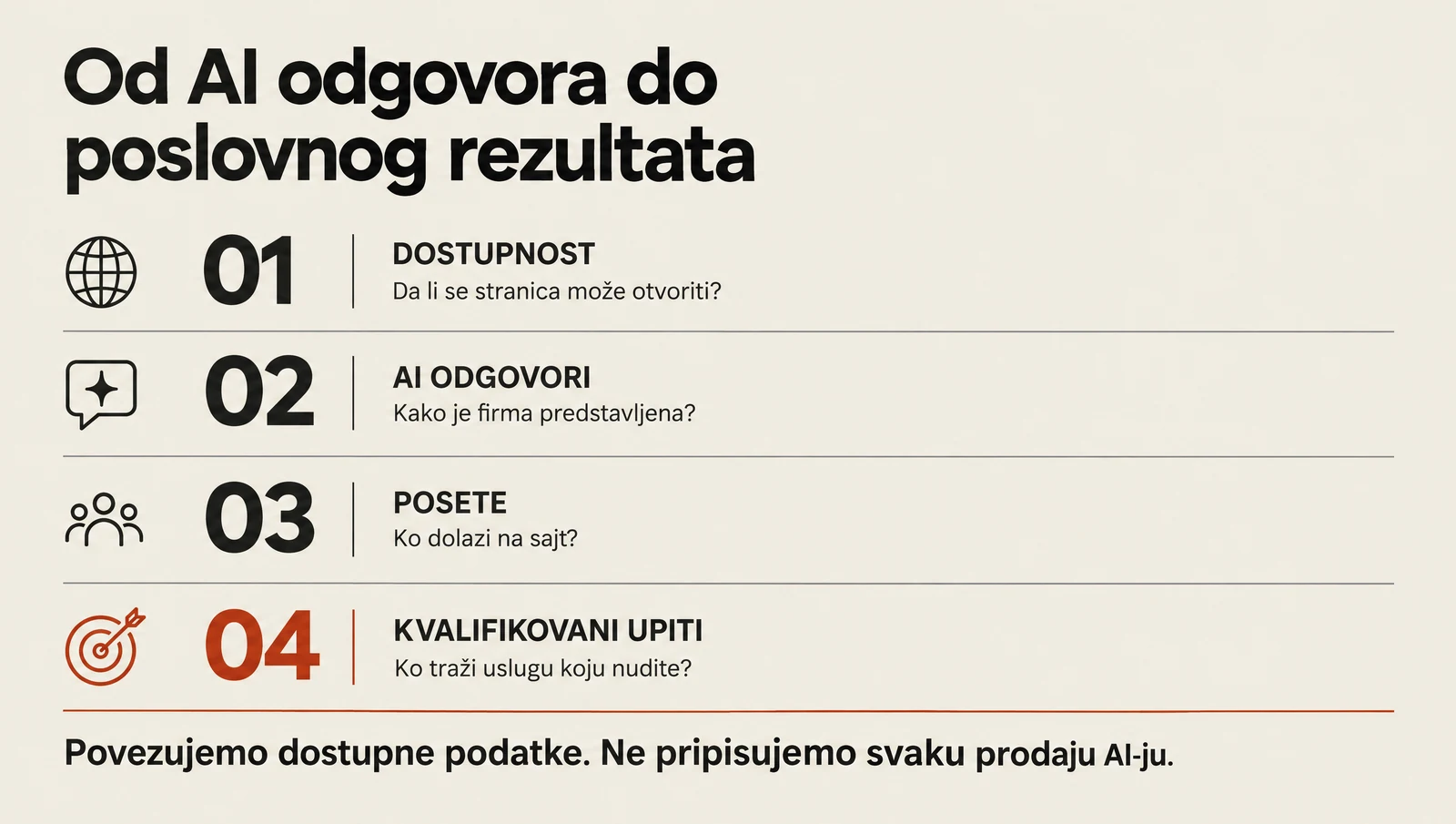
Text description of the graphic
- Accessibility: can the page open?
- AI answers: how is the company represented?
- Visits: who reaches the website?
- Qualified enquiries: who wants the service you provide?
- Do not attribute every sale to AI.
Answer records include question, date, platform, conditions, mention, cited URL, recommendation and accuracy. Mention percentages need a denominator: recorded answers in a defined sample, not market share or all ChatGPT users.
Track available visit sources and key actions. OpenAI's publisher FAQ says referrals include utm_source=chatgpt.com. Check analytics records and whether redirects or settings alter them.
This captures part of the journey. People may read a recommendation and later visit directly or contact you elsewhere. Supplement analytics with sales conversations, separating reported sources from recorded visits.
What does a useful business review contain?
For relevant enquiries, record service, market, qualification reason, stage and outcome. Keep records simple enough to maintain. Store personal information in appropriate business systems, not public reports.
Illustration: ten contacts with two suitable buyers and six contacts with four suitable buyers give different signals. Without quality, the larger count can look better. This is not a forecast; it explains why definitions matter.
More visits without suitable enquiries call for intent, offer and contact-journey checks. Inaccurate mentions call for source corrections. Insufficient data calls for recorded uncertainty and next checks. See AEO and GEO measurement.
What does ChatGPT optimisation cost?
Cost depends on starting condition, offers, languages, markets, content and technical work. Clarify implementation ownership. An advisory audit differs from an engagement including delivery.
For a proposal, I request domain, priority services, buyers, resources and measurement information. Separate one-off changes from ongoing work so you understand fees and your team's requirements.
- Initial analysis: buyer questions, presence and priorities.
- Technical work: specific fixes and access verification.
- Content: offer editing, expert articles, illustrations and updates.
- Sources and links: internal links and agreed off-site actions.
- Measurement: repeat checks, reporting and next-work proposals.
Do not choose by article count. Improving a critical page may outweigh several new posts. See SEO pricing factors. Your scope and investment are confirmed in a proposal.
How do you choose a ChatGPT optimisation agency?
Ask how tasks connect to buyer decisions. The first conversation should clarify goals, sources and implementation. Tool lists and acronyms say little about deliverables.
I would ask:
- Which buyer questions and services come first?
- How do you record baselines and AI-answer changes?
- What changes on the website, and what remains with my team?
- How are specialist claims and company information verified?
- Which sources and links are proposed, and why?
- How are mentions, citations, recommendations and qualified enquiries separated?
- What arrives monthly, and how is the next priority chosen?
Request a report and task example without confidential information. See the Sygnific sample audit to assess format and approach; actual findings depend on your website.
Guaranteed first place or recommendations warrant further questions. Agencies control work quality and delivery; platforms control sources and final answers.
Mistakes I would avoid
Many similar articles. Five URLs answering one question obscure the main source. Check existing content before publication and give supporting pieces distinct purposes.
Confusing search access and training. Decide and document OpenAI bot settings separately. Access does not promise answer inclusion.
Making schema or llms.txt the whole project. Assess their specific roles. Neither replaces clear offers, accurate information and access. See llms.txt's role and limitations.
Unverified claims. Invented success rates, unauthorised references and exaggerated experience damage trust. Detailed methods and limits are better.
Judging success from one answer. Answers vary and one question covers only part of a decision. Use agreed samples, repetitions and transparent records.
Content without an engagement path. Useful guides should enable contact when need becomes clear. CTAs should be specific and contextual, explaining the conversation rather than just “get in touch”.
Artificially extending content. Google's helpful-content guidance states there is no preferred word count. Long guides need real questions and sections worth the reader's time.
How would we work on your company's visibility?
Sygnific connects GEO and AI visibility to how companies explain and sell. First define the main service, buyer questions and verifiable obstacles together.
For an introductory call, send the website, audience and improvement goal. Existing enquiries and repeated sales questions help. No perfect brief is required.
Then agree on review scope and proposed work. Proposals should list deliverables, responsibilities, timing, measurement and investment. Your team confirms business and specialist information; we turn it into an agreed plan for content, access and tracking.
You should know what was done, what available data shows and why the next task matters. That is the foundation for a long-term partnership.
ChatGPT optimisation questions
How can my company appear in ChatGPT answers?
Start with accessible pages, clear offers, accurate information and useful buyer answers. Review public sources and repeat measurements. These improve foundations; the platform selects sources and answers.
Does optimisation guarantee recommendations?
No. Recommendations, positions and permanent appearances cannot be guaranteed. Agree on concrete tasks, checks, content and reporting, and assess documented work and business signals.
How long do results take?
It depends on starting condition, changes, source availability and platform behaviour. Technical fixes can be checked at completion; answer changes need repeated observation. Ninety days describes work and checks, not a guaranteed recommendation deadline.
Must GPTBot be allowed for search visibility?
Search and possible training are separate. OAI-SearchBot is relevant to search; companies choose GPTBot policies independently.
Do I need a new website?
A review determines that. Often existing pages, content and access can be improved first. Recommend rebuilding only for specific limitations, with explained scope and costs.
Are FAQs and structured data enough?
FAQs help real concerns, and structured data helps accurate descriptions. Relevant offers, evidence, access, links and measurement are still needed. Markup does not secure AI recommendations.
Can the same content work for Google and ChatGPT?
Clear useful content can serve visitors from different searches. Adapt technical checks and measurement per system rather than duplicating articles by platform name.
How do I know an enquiry came from ChatGPT?
Review analytics sources and UTM data and connect contacts where possible. Ask clients how they found you. Separate measured and reported information because full journeys are not always visible.
Does this make sense for a small company?
It can, with relevant buyer questions and realistic implementation. Start with one important service, a few questions and improved key pages. Match scope to value and resources.
How do I engage Sygnific?
Send your domain and priority service. During the introductory conversation, we clarify goals and agree on the next step. If there is a basis for collaboration, we prepare scope, responsibilities and tracking in a proposal.