

A campaign landing page has a defined audience, offer and main call to action. For a service business, it should explain suitability, deliverables and what happens after an enquiry. Good copy, evidence and a functional form work together.
In analytics, a “landing page” is any page where a visit starts. Here, I mean a dedicated offer page. My first test is practical: without the logo, could I still understand the offer, audience and reason to talk?
Start with one buyer decision
Before design, I would record the audience, its problem, the specific offer and next step. If these cannot be explained in a few sentences, the page will probably compensate with length.
Imagine a B2B company offering a security review of an existing system. Visitors need scope, participants, access requirements and the resulting document. “Complete digital transformation” does not provide enough to decide.
The principle also applies to schools, hotels and specialist stores, though actions differ: programme discussions, appointment enquiries or product recommendations. These examples explain the approach, not client results.
What should a landing page contain?
Adapt sequence to offer complexity. Simple requests need less explanation; expensive or risky decisions require answers before asking for contact.
| Page section | Question to answer |
|---|---|
| Headline and introduction | What do I get, and is this for me? |
| Scope | What exactly is included? |
| Evidence | What supports your claim to help? |
| Process and limitations | What is expected of me, and what is excluded? |
| CTA and form | What happens after I send my details? |
Evidence can be a real case study with context, a deliverable example or publicly verifiable expertise. Without approved client results, I would rather show a sample report than a decorative percentage of unknown origin.
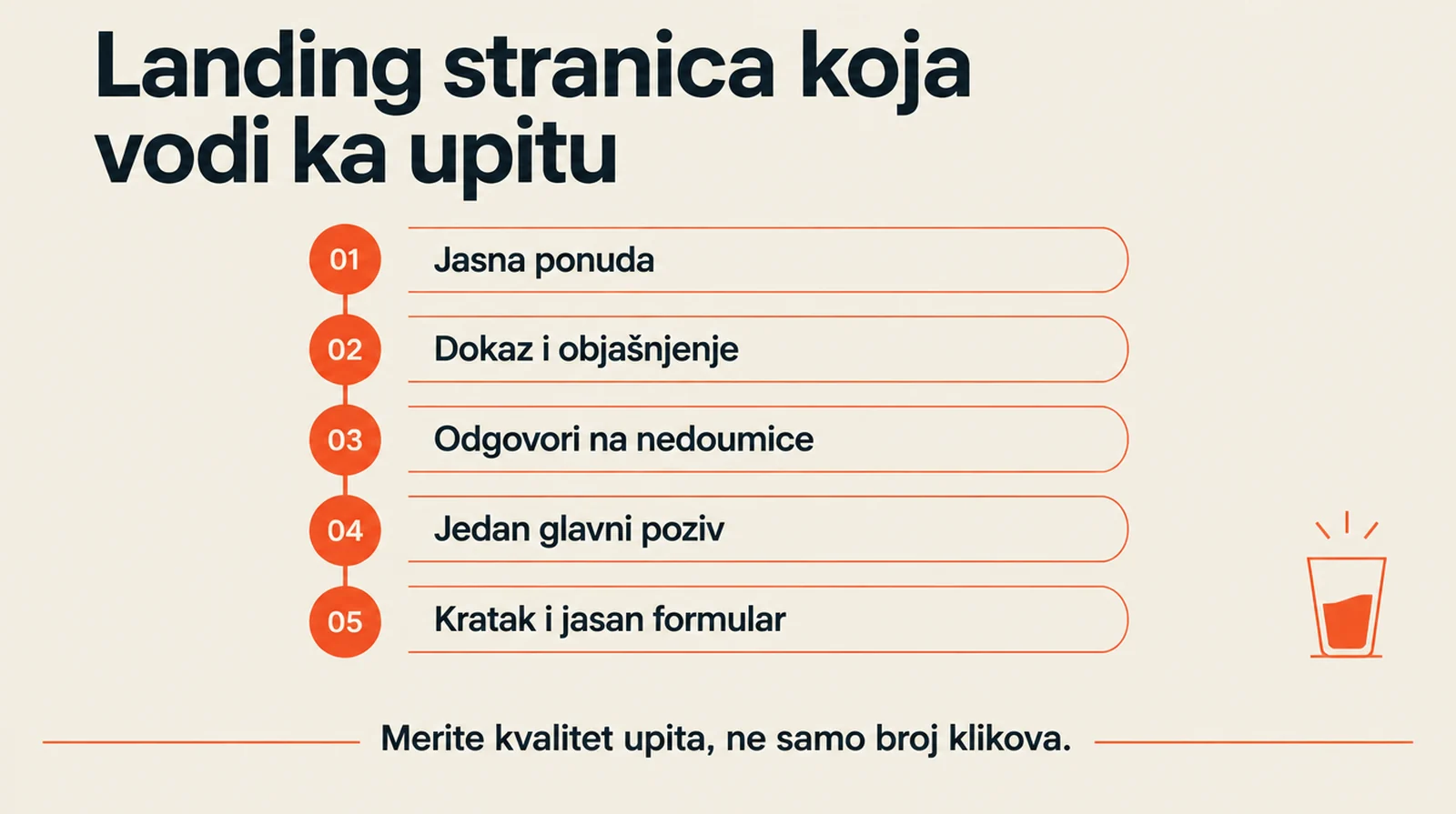
Text description of the graphic
- 01 Clear offer
- 02 Evidence and explanation
- 03 Answers to concerns
- 04 One main action
- 05 A short, clear form
- Measure enquiry quality, not only clicks.
How would I write the headline and CTA?
Name the offer and useful change. For an illustrative audit, “Find the obstacles making your website hard to discover” explains the work better than “Unlock digital success”. Briefly state coverage and suitability.
The main CTA must match the actual step. If visitors discuss scope, “Book a conversation” is more accurate than “Download your complete audit”. If a form follows, explain who responds and what happens next.
Repeat the same main CTA after key sections on long pages. One main goal does not mean removing privacy, terms, contact or all supporting links. Keep information needed to decide without several equally prominent offers.
Collect enough form information for the next step
Field count should follow the actual sales process. A first conversation often needs basic details and a short question. Complex projects may justify scope or budget questions upfront, with an explanation.
Check visible labels, mobile keyboards, understandable errors and clear success confirmation. W3C accessible-form guidance provides practical foundations for labels, instructions and feedback.
Test the whole path: submission, receipt at the right address or system, visitor confirmation and handling. A working-looking button is insufficient if requests do not reach the right person. Production tests should use clearly labelled test enquiries and an agreed procedure.
How does a landing page connect to SEO, AEO and GEO?
An organic-search page should answer intent and belong to a sensible site structure. Use a descriptive title, one main heading, clear offer copy and links from relevant guides. Plan the SEO foundation before final design.
For AEO, make questions and answers precise enough to explain terms immediately. For GEO, check consistent company, service and authorship data and AI-answer representation. This belongs to GEO and AI visibility, without guaranteeing selection.
A short campaign-test page may differ from a permanent SEO service page. Decide indexing and canonical treatment from its content and relation to existing URLs, rather than automatically indexing or excluding all campaign pages.
The ad and page must promise the same thing
If an ad promotes a service, the first screen should confirm it. Buyers should not search the whole site to establish they are in the right place. The same applies to advertised prices, locations and terms.
Google Ads includes landing-page relevance and usefulness in Quality Score diagnostics. I use it as a supporting signal and assess business performance through enquiries and sales. If choosing a channel, see SEO or Google Ads.
How do I check whether it works?
Separate visits, CTA clicks, started and submitted forms, qualified enquiries and new clients. Counting only button clicks can declare success before most people abandon.
For this check, conversion rate would be sessions starting on that landing page with at least one valid form submission divided by all sessions starting on the same page. Numerator and denominator then refer to the same visit group. Use sales records for quality. Definitions, period and exclusion of test or duplicate requests must match across comparisons.
Write a hypothesis: “Visitors do not understand what the conversation provides; a short explanation by the CTA may reduce uncertainty.” Then examine relevant data. On low traffic, a few visits cannot establish a test winner; buyer conversations and obstacle reviews may be more useful first.
For site-wide problems, start with why websites fail to turn visits into enquiries. For one page, we use conversion optimisation with agreed measurement.
Frequently asked questions
Is a landing page always better than a homepage?
It depends on visit intent. Specific campaigns benefit from matching pages; a homepage presents the company and directs different audiences.
Does a shorter form always perform better?
It can increase submissions, but quality matters too. Retain information needed for a useful next conversation and remove questions without a purpose yet.
Does every keyword need a new landing page?
No. Variations of the same intent often belong on one strong page. A new URL makes sense when the offer, audience or decision differs.