

Your product can appear in an AI recommendation while another store receives the order. That is my starting point for serious AI shopping discussions. Brand mentions help, but store owners need to understand customers, sales and profit.
As Sygnific's owner, I consider three questions: can the system find and understand the product, is there a reason to select it for a specific buyer, and why should that buyer choose your offer? Another optimised blog post is unlikely to solve a missing answer.
This guide explains my ecommerce GEO, AEO and SEO approach, from catalogue priorities and product data to content, evidence, recommendation checks and business results. Examples demonstrate the method, not client results.
1. AI selects products, but buyers still choose sellers
Imagine someone seeking a light commuting backpack with laptop space and compact travel dimensions. AI can narrow the choice to several models. The same model may be sold by its manufacturer, a major retailer and a small specialist store.
Two separate tasks emerge. Manufacturers explain which needs their product suits. Sellers explain why buying it from them makes sense. If you do both, address both. If you sell other brands, copying manufacturer descriptions hides much of your own value.
OpenAI says product selection considers relevance and available information. Merchant selection also considers availability, price, quality and manufacturer or primary-seller status. This is not a published ranking formula, but supports examining product and offer separately. Source: how ChatGPT selects products and merchants.
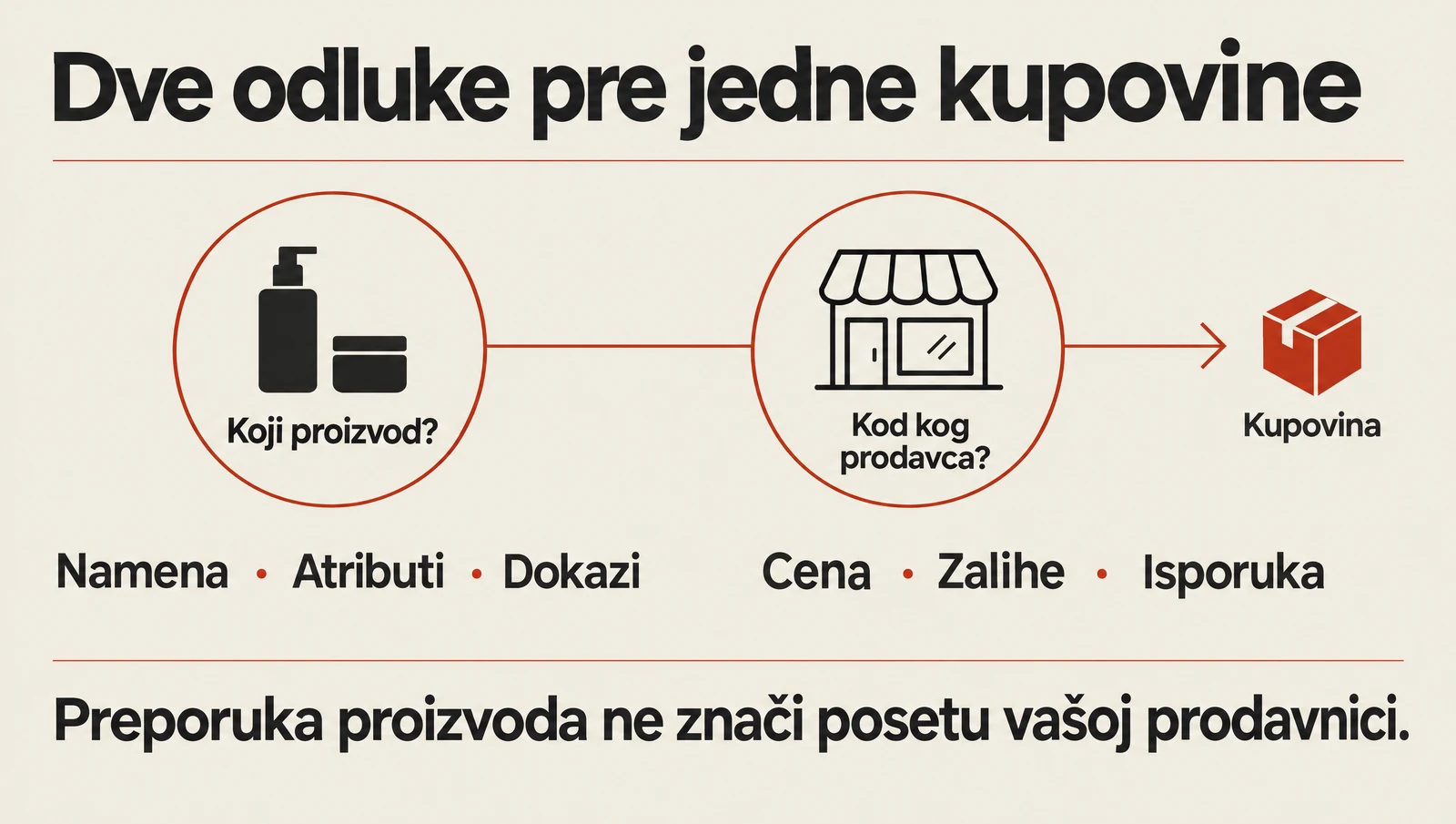
Text description of the graphic
- Which product? Purpose, attributes and evidence.
- Which seller? Price, stock and delivery.
- A product recommendation does not mean a visit to your store.
For each priority product, finish two sentences: “This suits a buyer who…” and “Buying from us makes sense because…”. If the latter only says “good price”, consider variants, delivery, support, installation, spare parts and complaints handling. State what you actually offer.
2. How ChatGPT shopping and AI recommendations work
Buyers can describe budgets, uses and constraints, then refine requests. Translate these situations into criteria. “Backpack” differs from “a laptop backpack fitting under a seat without a sporty look”. The latter requires details generic descriptions miss.
ChatGPT shopping research documentation describes merchant data through Agentic Commerce Protocol, public product information and other retail sources. Do not assume one platform or page type controls every recommendation.
For planning, I distinguish three levels:
- Research: understanding categories, needs and trade-offs.
- Recommendation: considering products and sellers.
- Transaction: confirming orders and payment through a supported flow.

Text description of the graphic
- Research: comparing options.
- Recommendation: AI selects products.
- Transaction: the buyer confirms the order.
- Check availability for each market and platform.
This is a working framework, not one algorithm's description. It prevents promising payment integration while delivering research content and helps select metrics appropriate to guides versus product pages.
Agentic commerce can involve an agent executing purchases through supported integrations. Before development, establish where orders are confirmed, who processes payments and who provides support. A feature's marketing name is not a sufficient technical requirement.
3. What applies to an online store from Serbia?
ChatGPT availability in a country does not establish availability of every shopping feature. Separate domestic-only stores from companies selling to US or other markets. Content language, currency, logistics and platform terms must fit target buyers.
At the source check on 9 October 2026, Shopify's ChatGPT channel required selling to US customers, while stores could be registered elsewhere. Checkout takes place on the store's checkout through an in-app browser or new tab. Do not describe it as universal conversational checkout or automatic eligibility for Serbia-only stores. Source: Shopify ChatGPT channel conditions.
For eligible Shopify stores, check the existing setup first: the channel is enabled by default and data is shared through Shopify Catalog. Do not start unnecessary applications or development.
OpenAI also offers a merchant application for catalogue sharing. An application does not confirm acceptance, every country's support or guaranteed product display. Verify the actual merchant's status before planning integration.
For Serbian businesses, first improve public information, products and shopping experience, then check catalogues and integrations, then plan development. Accurate specifications, useful categories and a reliable offer have value even while a feature remains unavailable.
For broader company representation, see ChatGPT optimisation. Here the focus is ecommerce products, variants, offers and orders.
4. Start with worthwhile products, not the whole catalogue
A store with thousands of products need not fix everything at once. Start with a group, for example 20 products in one important category. This is a pilot-management choice, not an AI requirement.
Consider profit contribution, actual availability, differentiation, data quality and implementation capacity. High-margin items constantly out of stock may be poor first candidates, as are products lacking image rights or confirmed specifications.
| Criterion | Team question | Decision |
|---|---|---|
| Business value | What remains after procurement, delivery and expected returns? | Prioritise sustainable profit |
| Stock | Can priority variants be delivered reliably? | Do not promote permanently unavailable offers |
| Reason to choose | Which buyer particularly benefits? | Define use and limitations |
| Evidence | Are specifications, photographs and authentic experiences available? | Resolve gaps first |
| Feasibility | Who changes catalogue, content and integrations? | Assign an owner |
Include procurement and support. Marketing knows search terms; support knows return reasons. Without both, more people may buy unsuitable products, increasing revenue while reducing profit.
5. Catalogue, product feeds and schema must agree
A product feed shares structured catalogue data with platforms. A product page explains the offer to buyers. Structured data, often JSON-LD, describes page content to machines. Publishing one does not establish the others are correct or connected.
OpenAI's product-feed documentation describes current prices, availability and merchant context. Check fields, format and access in the current specification and approved integration, rather than building from old screenshots or someone else's export.
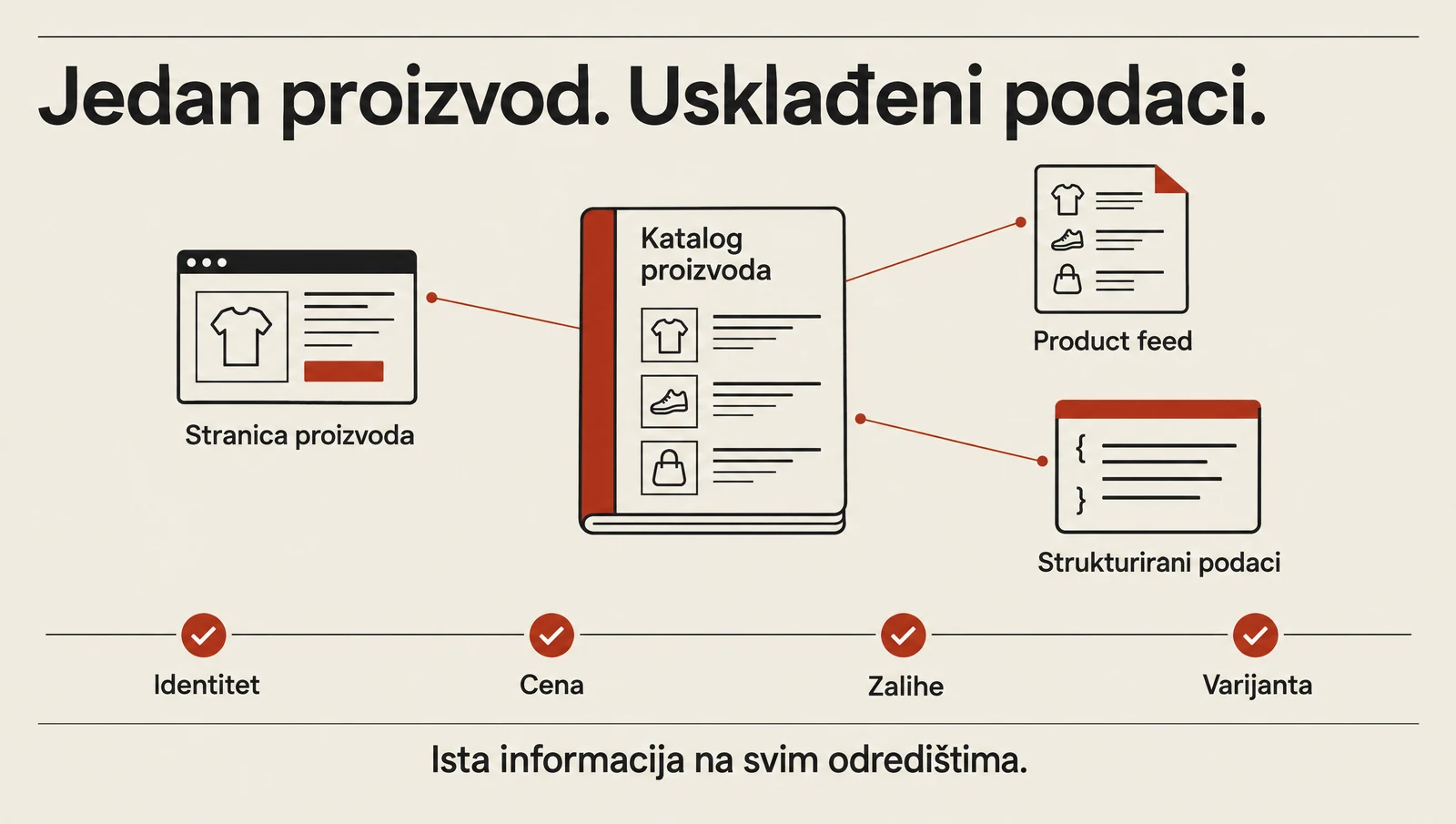
Text description of the graphic
- The catalogue connects to product pages, product feeds and structured data.
- Check identity, price, stock and variant.
- Keep information consistent across destinations.
Define data sources and responsibility first
Prices and stock may come from ERP, descriptions from PIM or CMS, and delivery from operations. Define which system wins when values disagree. Otherwise, an overnight import may undo today's correction.
For each priority item, record internal code, brand, model, variant, specification source, URL, data owner and last successful check. This is more useful than an unexplained “AI ready” label.
Check identifiers and variants carefully
Google's product data specification covers identifiers, price, availability and attributes. Use genuine, accurate GTINs and MPNs; do not invent them. Google feed rules are not universal AI-channel rules.
Check simple expensive errors: black photos for grey variants, pack prices for one unit, box dimensions instead of product dimensions or parent-model stock instead of a selected size. Better introductions cannot fix variant errors.
Structured data describes offers, not invented reputation
Google Product and Offer documentation explains supported price, availability, delivery and return displays. Match actual page content and validate implementation. Correct schema does not guarantee rich results or AI recommendations.
Do not invent ratings, review counts or terms. Modest accurate markup is better than impressive JSON-LD contradicting the offer. Check representative variants after changes and automate mismatch monitoring for large catalogues.
6. Product pages should help people decide
My first editorial test removes the brand name: could the description fit ten other products? If so, it is probably too generic. “Great quality, modern design and maximum practicality” does not establish suitability.
For priority pages, explain suitability, key verified attributes, intended use, limitations, package contents and purchase information. Not every category needs long copy, only enough to resolve actual concerns.

Text description of the graphic
- Vague: excellent backpack, outstanding quality, for every occasion.
- Verifiable fictional example: 22 l; laptop up to 15.6 inches; dimensions 45 × 30 × 16 cm.
- Enter only confirmed information.
Illustrative example: a 22-litre backpack, 45 × 30 × 16 cm, with a declared compartment for laptops up to 15.6 inches. These are invented specifications to explain the method.
Rather than “ideal for every trip”, write: “A backpack for carrying a laptop and work essentials. Before flying, compare external dimensions with your airline's current rules.” Do not add unverified waterproofing because queries mention it. State known limitations.
Photographs and graphics should establish something
For real products, show compartments, dimensions, closures and scale against familiar objects. Packaging photos clarify contents; material details can answer concerns lifestyle shots do not.
AI illustrations can explain concepts and processes, like this article's graphics. Do not use them as proof of actual appearance, accessories or performance. Wrong product imagery can undermine conversion work.
Explain whom the product does not suit
Sellers often avoid limitations for fear of losing sales. I prefer directing unsuitable buyers to a better model. If a backpack cannot fit a large laptop or is unsuitable for hiking, connect the limitation to a relevant alternative.
This helps sales and support. It is not a claim about a secret ranking factor; it makes offers clear, verifiable and comparable.
7. Content, comparisons and links should follow buyer concerns
I would not publish fifty “best” articles always ranking the same product first. Map decisions: what buyers do not know and which content moves them forward.
For the backpack: capacity, business versus hiking models, laptop compartments and product comparisons. Appliances need capacity, fitting dimensions, consumption and servicing. Cosmetics require different evidence and careful efficacy claims.
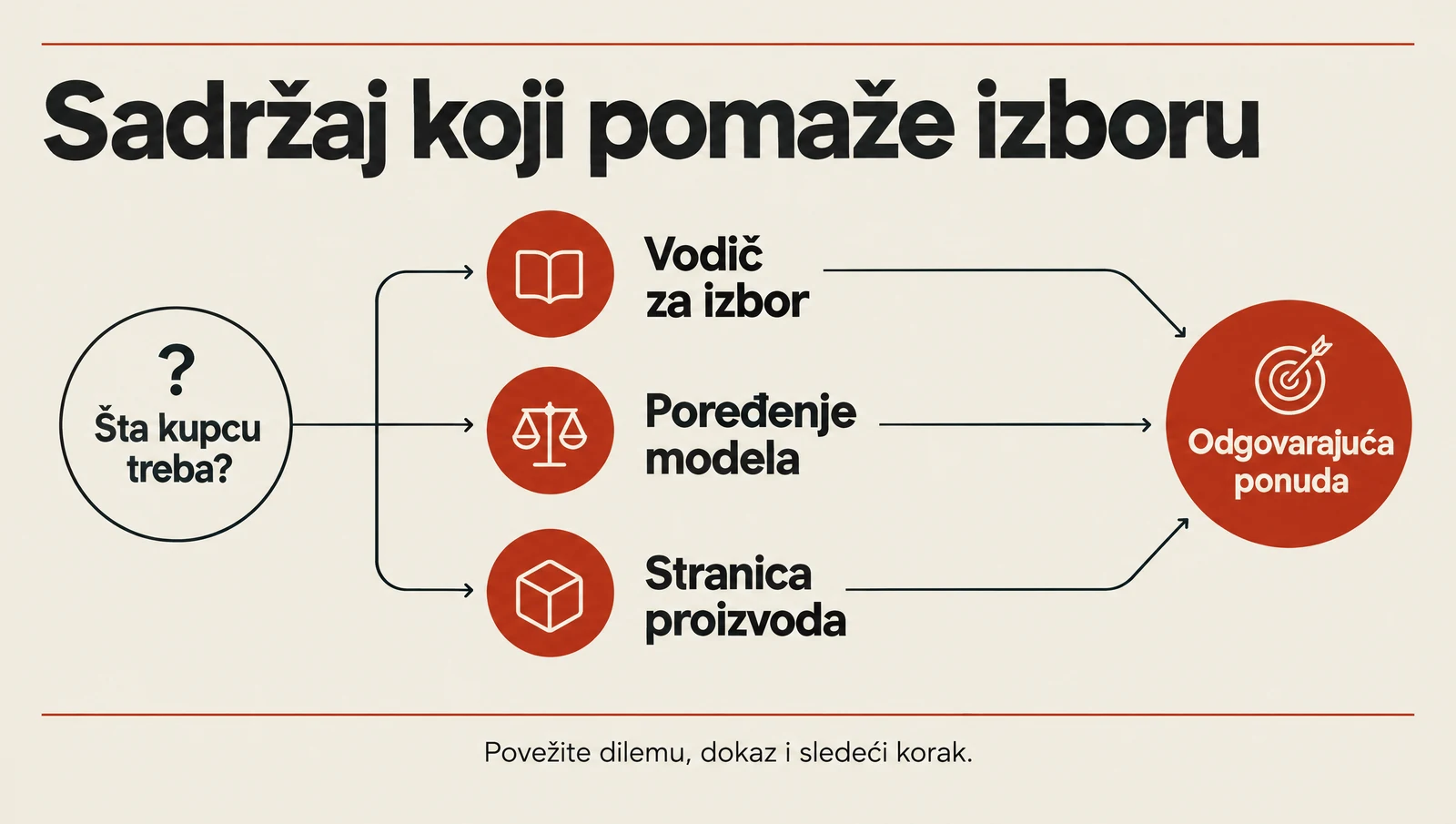
Text description of the graphic
- Start with what the buyer needs.
- Selection guides, model comparisons and product pages lead to a suitable offer.
- Connect the concern, evidence and next step.
| Buyer question | Page type | Useful next step |
|---|---|---|
| How do I choose? | A criteria-based guide | A category with suitable products |
| What is the difference? | Models compared on shared criteria | A product meeting the need |
| Does it suit me? | A product page including limitations | Variant selection or advice |
| Why buy here? | A clear seller offer | Basket, contact or delivery check |
How I would structure internal links
Link guides to relevant categories and selected models, products back to comparisons where needed, and categories to selection guides. Use descriptions such as “compare business-backpack dimensions” rather than repeated keyword anchors.
Do not link just because pages share “AI” or “shopping”. Ask whether the destination answers the reader's current question. Here, our ecommerce approach provides business context and the content service explains working on those pages.
External evidence should be real and verifiable
Link specifications to manufacturer documentation. For tests, identify who, how and when. Store comparisons should disclose what the store sells. Collect authentic customer experiences without conditioning positive ratings.
Reputation work can involve expert reviews, relevant media, knowledgeable authors or test data. Do not purchase claims presented as independent experience. Disclose commercial relationships. Give third parties a reason to assess products rather than simulate endorsement.
One clear methodological test can be more useful than many vague compliments. Whether AI uses it is checked separately; publication counts do not promise recommendations.
8. Technical accessibility: check actual site responses
Do not stop at robots.txt. Check content responses, security challenges, unintended indexing blocks and access without mandatory login. For catalogues, verify stable variant URLs.
OpenAI separates search-oriented OAI-SearchBot from training-related GPTBot, with independent settings. Training decisions should not automatically determine search access. Source: OpenAI crawler documentation.
With developers, check server responses and logs, verifying crawler identity through platform documentation. Changing a test user-agent alone does not prove how the real crawler passes every protection layer. Check image access, formats, dimensions and product accuracy.
URL changes need redirects and updated links. Sitemaps should list canonical indexable pages and genuine change dates. Feed validation, indexing and answer appearance are separate statuses. “Submitted” is not “accepted”; “accepted” is not “recommended”.
9. Measuring AI visibility without flattering results
Reports should connect changes with verifiable evidence. Separate appearance, accuracy, recognised visits, confirmed orders and profit contribution. A favourable screenshot is an initial observation, not business reporting.
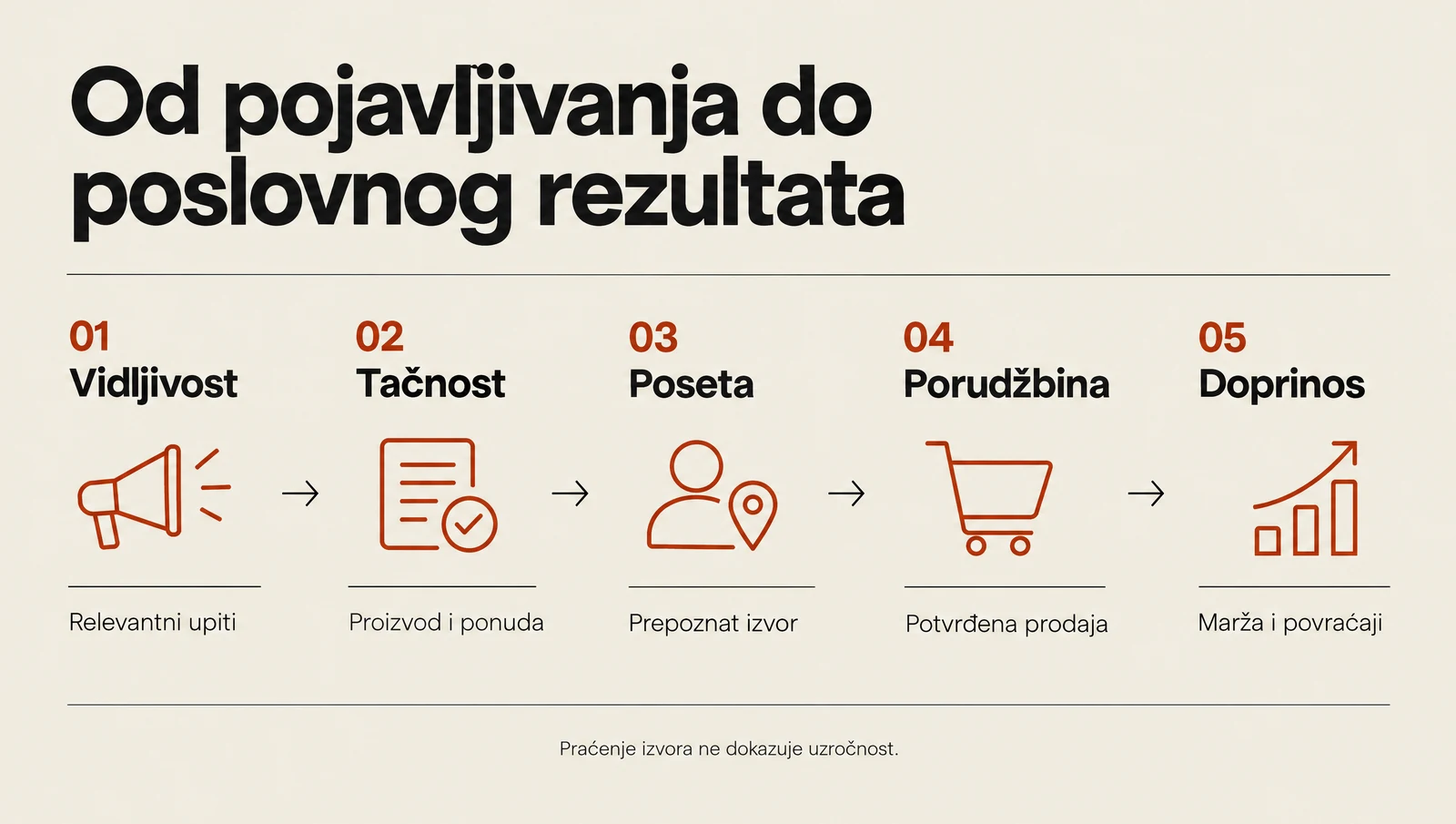
Text description of the graphic
- Visibility: relevant queries.
- Accuracy: product and offer.
- Visit: recognised source.
- Order: confirmed sale.
- Contribution: margin and returns.
- Source tracking does not prove causation.
Build a stable question set and record conditions
For a pilot category, include use, limitations, comparisons and buying. Some questions contain the brand, others do not. Record platform, date, language, market, features and personalisation. Repeat and save answers omitting you too.
Run independent questions in new conversations with consistent search and memory settings. Keep deliberate follow-up conversations in a separate group to distinguish initial recommendations from clarified requests.
Record whether your product appears, your store is listed, a link exists and information is accurate. For wrong prices, trace the incorrect source, update time and delivery to the destination channel before editing blindly.
For a product, appearance rate is relevant valid answers containing it at least once divided by all relevant valid answers in the sample. Separately calculate the share listing your store as seller. Count an answer once per metric.
Illustration, not client results: a product appears in four of ten comparable answers and your store in two. That is 40% and 20%, each with denominator ten. Always state sample size. These are not market share, all-conversation estimates or guarantees of the next buyer's experience.
Connect visits and sales carefully
Separate recognised AI-source visits and connect behaviour to confirmed transactions. Some journeys remain unseen: buyers may remember a name and return another way. Reports distinguish records, estimates and unknowns.
For pilots, track labour cost, product contribution and returns. More orders with greater costs or unsuitable purchases are not automatic success. Where data allows, compare similar product groups and record promotions, prices, stock and seasonality. Post-intervention growth still does not alone establish causation.
The AEO and GEO measurement guide separates presence, traffic and enquiries. Ecommerce adds orders and product economics.
10. The first 90 days: what the team does
Ninety days is an organisational framework, not a recommendation or ROI guarantee. Adapt it to catalogue scope, data and team capacity.

Text description of the graphic
- Days 1–30: data and baseline; catalogue, access and measurement.
- Days 31–60: content and offer; pages, comparisons and evidence.
- Days 61–90: testing and priorities; checks, sales and next steps.
- A work framework, not a result deadline.
Days 1–30: baseline and data fixes
Select categories and products, record the baseline and agree on the business goal. Check integration eligibility, data sources, variants and access. Deliver priorities with owners and completion criteria, not merely a long PDF.
Days 31–60: pages, comparisons and clear offers
Improve selected pages, verified attributes and actual photography. Write guides and connect offers. Check feeds and schema. Procurement verifies specifications, support contributes common problems and marketing approves communication.
Days 61–90: repeat checks and expansion decisions
Repeat the question sample, check accuracy and analyse recorded visits and sales. Unapproved channels or unavailable products remain open issues. Decide whether to expand, fix bottlenecks or reprioritise from findings.
Ask agencies to identify dependencies: guides may need confirmed specifications; feeds may need platform access. Owners can then see what blocks progress and who can resolve it.
11. What I expect from an AI and ecommerce agency
In specialists' public offers, work structure is more useful than package names. Aleyda Solis's Orainti connects SEO and AI search consultancy with ecommerce growth, audits, strategy and training. Lily Ray's Algorythmic offers AI search consulting, content quality, authority and analytics reviews. Mike King's iPullRank describes retail search audits and measurement planning.
These are publicly described services, not independently verified results or a recommendation that every company needs the same scope. Seek a partner connecting strategy, data, content, implementation and evaluation.
Before a proposal, ask: what are the deliverables, who implements technical changes, how is accuracy checked and how do we decide to keep investing? “More mentions” alone omits the business connection.
Ten-product manufacturers and 50,000-item retailers need different scopes. The former may prioritise positioning and documentation; the latter data, variants and prioritisation. Fit work to the actual problem.
12. How I would structure this at Sygnific
Start with categories, buyers and offer economics. An AI visibility audit separates immediate fixes from dependencies on data, development and channel availability.
Define baseline, buyer-question map, product priorities, content plan, technical tasks and measurement. For feeds or business-system changes, agree on your developers' responsibilities and our scope in advance.
GEO and AEO target answer visibility; SEO supports discovery and structure; analytics connects measurable activity. When visits exist but purchases stall, add conversion optimisation.
Clients should understand where opportunities are lost, what we improve next and the evidence behind it. That supports a long-term partnership.
AI shopping questions
Does online-store SEO still make sense?
Yes. Clear categories, accessible pages, useful descriptions and links remain foundations. AI visibility adds product and source checks without replacing the website where buyers choose and purchase.
Does ad spending secure organic ChatGPT recommendations?
Do not equate them. OpenAI says product results are separate from ads and partnerships do not determine organic selection. Check the product-selection explanation alongside current advertising terms.
Is a product feed enough?
Not as a complete project. Feeds transmit data; buyers still need clear offers, reliable delivery and answers. Check sources, destination pages and integration status too.
Can a Serbian company sell through ChatGPT?
It depends on buyer markets, platform and channel. Shopify's channel currently requires US customers. This is a specific integration condition, not a general ban on discovering Serbian stores. Check the actual account.
Does a small store need a large starting budget?
I suggest a limited pilot in one important category. Investment depends on data, technology and content. Before expansion, establish completed work, open issues and evidence to continue.
How quickly can I expect results?
Offer errors may be fixed immediately; platform refreshes, indexing and recommendations move differently. Separate our delivery deadlines from external-system outcomes. I do not promise a first-recommendation or sales date.
Technical sources and feature availability checked 9 October 2026. Platform conditions may change and are verified for the actual account and market before implementation. Graphics illustrate original frameworks and examples, not any platform's internal algorithm.