
To work on company visibility in ChatGPT search, start with an accessible website, clear offer, accurate brand information and sources confirming it. Then check how the company is represented in repeated answers to questions important to buyers.
My first choice would be reviewing the homepage, service page, About page and contact page. If visitors cannot explain what you offer, to whom and on what terms, there is concrete work to do.
This applies even to grammatical, attractive copy. “We combine innovation and excellence” takes space but does not help a buyer assess whether you solve their problem.
For the whole process, from initial audit and technical checks to content and enquiries, see the complete ChatGPT optimisation guide. Here, I focus on company information to improve first.
Start with a clear business description
I recommend answering four questions: what you do, for whom, in which market and how collaboration starts. It need not fit in one headline, but it must be easy to find.
An illustrative comparison for a fictional B2B company:
| Before | A more specific description |
|---|---|
| “Your digital transformation partner” | “We develop production-equipment maintenance software and connect it to the factory's existing systems.” |
| “Tailored solutions” | “Before proposing a solution, we map equipment, user roles and the data to exchange.” |
| “Outstanding support” | “Support scope, hours and response times are defined in the contract.” |
This shows the type of information I seek. Specific claims must reflect the actual service and confirmed company terms.
What belongs on a service page?
Help buyers quickly understand when the service makes sense, what they receive and what to prepare. Usually this requires a problem description, concrete deliverables, process, limitations and next step.
Prices may be public or depend on scope. If scope-dependent, explain the factors and information needed for a proposal. You can give a useful answer without a price list.
Details vary by business. An online store should explain product differences and purchase terms. A hotel needs precise facilities, location and booking information. An education programme should state suitability and entry expectations.
For complex topics, I would use expert content explaining the offer, with examples your team can verify.
ChatGPT search access: what should you check?
OpenAI documents OAI-SearchBot as a search crawler and GPTBot as collecting content potentially used for model training. Settings are independent. Do not confuse search access with training permission. See OpenAI's crawler explanation.
A practical review covers robots.txt, indexing directives, server response and main-content access. Check whether hosting protection or login requirements alter the page's behaviour.
Check other platforms individually. Perplexity documents its crawler and access checks. One bot's name does not define rules for every AI system.
Even with access allowed, source selection and answer content remain platform decisions. Access is verifiable, not confirmation of a future recommendation.
Align company identity where you have control
Compare company name, domain, contact details, locations, main services and relevant qualifications. The homepage, About page and public profiles should present an accurate, consistent business.
Consistency does not mean copying a paragraph everywhere. It means profiles do not promise discontinued services, locations are current and responsibility for the offer is clear.
Use real author names and verifiable experience descriptions. At Sygnific, articles link to the author and agency page. Google also recommends clear authorship context in its helpful content guidance.
For location-dependent companies, this also includes local SEO and Google Business Profile: accurate details, a relevant link destination and verified contacts.
How would I use internal and external links?
An internal link should help readers continue their answer. An AI visibility article naturally connects to the GEO service, checking methodology or measurement explanation. Every paragraph need not lead to a sales page.
I place external links beside specific claims they support. Platform rules link to platform documentation; research findings to the original paper. Link text should set expectations, in line with Google's link and anchor-text guidance.
If another website misrepresents a company, record the exact issue and check the normal profile-correction process. Fabricated reviews, purchased statements and unverified awards cannot build the trust we seek.
What can schema explain?
Structured data can describe a company, author, article and other elements actually present on the page. I would add it after verifying that values match visible content.
For example, Article documentation explains headline, author and date fields. It provides an orderly technical description of a published article. Adding markup alone does not prove ChatGPT will use it or recommend the company.
The sequence I recommend
First choose one priority service. Improve its description, connect appropriate company information and check accessibility. Then review relevant public sources and create a tracking question panel.
Next, repeat the checks. The AI visibility measurement guide separates mentions, citations, recommendations and business enquiries. For a baseline and priorities, see the AI visibility audit.
For implementation support, explore our GEO optimisation approach. During a conversation, I first want to understand the buyer's decision and missing information.
This provides a useful starting point: one important topic, accurate information and a clear way to track what follows.
For the broader framework, see the relationship between SEO, AEO and GEO.
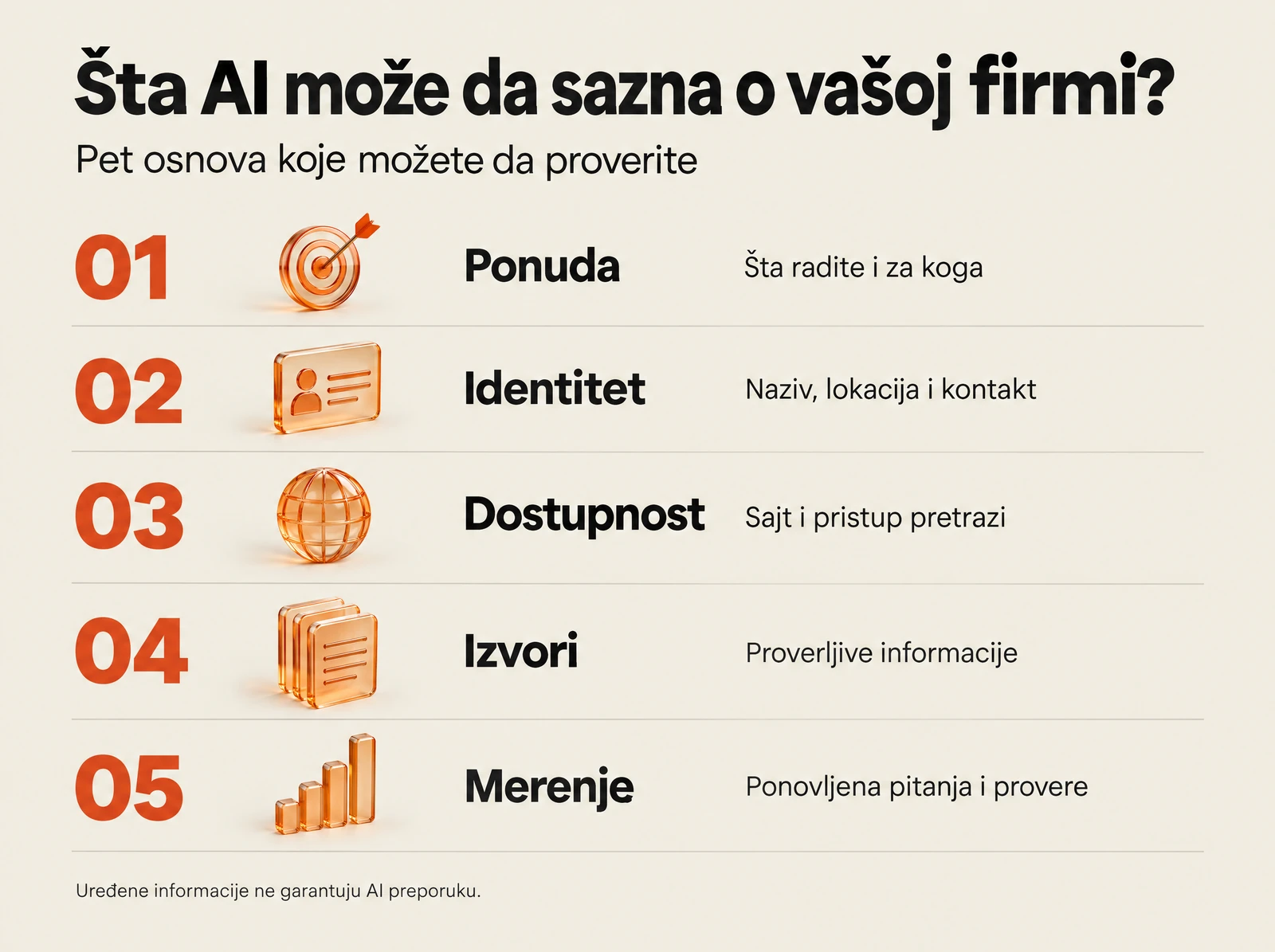
Text description of the graphic
- 1. Offer: what you do and for whom.
- 2. Identity: name, location and contact.
- 3. Accessibility: website and search access.
- 4. Sources: verifiable information.
- 5. Measurement: repeated questions and checks.
- Organised information does not guarantee an AI recommendation.