

SEO develops website visibility in search engines. AEO helps content answer specific questions more clearly. GEO concerns content and brand visibility in generated AI answers. These areas overlap, but their business value needs different findings and measures.
I believe a GEO conversation should begin with a question your potential client asks before buying. Only then can we discuss pages, sources, citations and missing content.
For a complex B2B service, it might be, “How do I choose a supplier who can connect to our existing system?” For a hotel: “Which accommodation suits a family needing parking and a separate bedroom?” Such questions reveal what a brand must explain to enter consideration.
At Sygnific, GEO and AI visibility are central to this work. SEO, content and measurement provide foundations and connect visibility to an actual business goal.
To apply this framework to one platform, see my detailed ChatGPT optimisation guide, with seven steps, a work plan and measurement.
What do SEO, AEO and GEO mean in practice?
Acronyms matter when translated into tasks. The following table is my practical way of separating focus, not a universal service standard.
| Area | Business question | Example task | What we check |
|---|---|---|---|
| SEO — Search Engine Optimization | Do people find relevant pages through search? | Improve indexing, content and internal links on a service page | Impressions, clicks, relevant queries and entry pages |
| AEO — Answer Engine Optimization | Does content give an understandable answer to a buyer's question? | Clearly explain suitability, process and limitations | Answer completeness and accuracy; presence in selected formats |
| GEO — Generative Engine Optimization | How is the brand represented in generated answers? | Check buyer questions, sources and presentation of the offer | Mentions, citations, recommendations and accuracy in a defined sample |
A research paper defines a framework for optimisation and visibility measurement in generative systems. I would not turn experimental results into a promised client growth percentage. Research conditions, language, platform and real market queries can differ substantially.
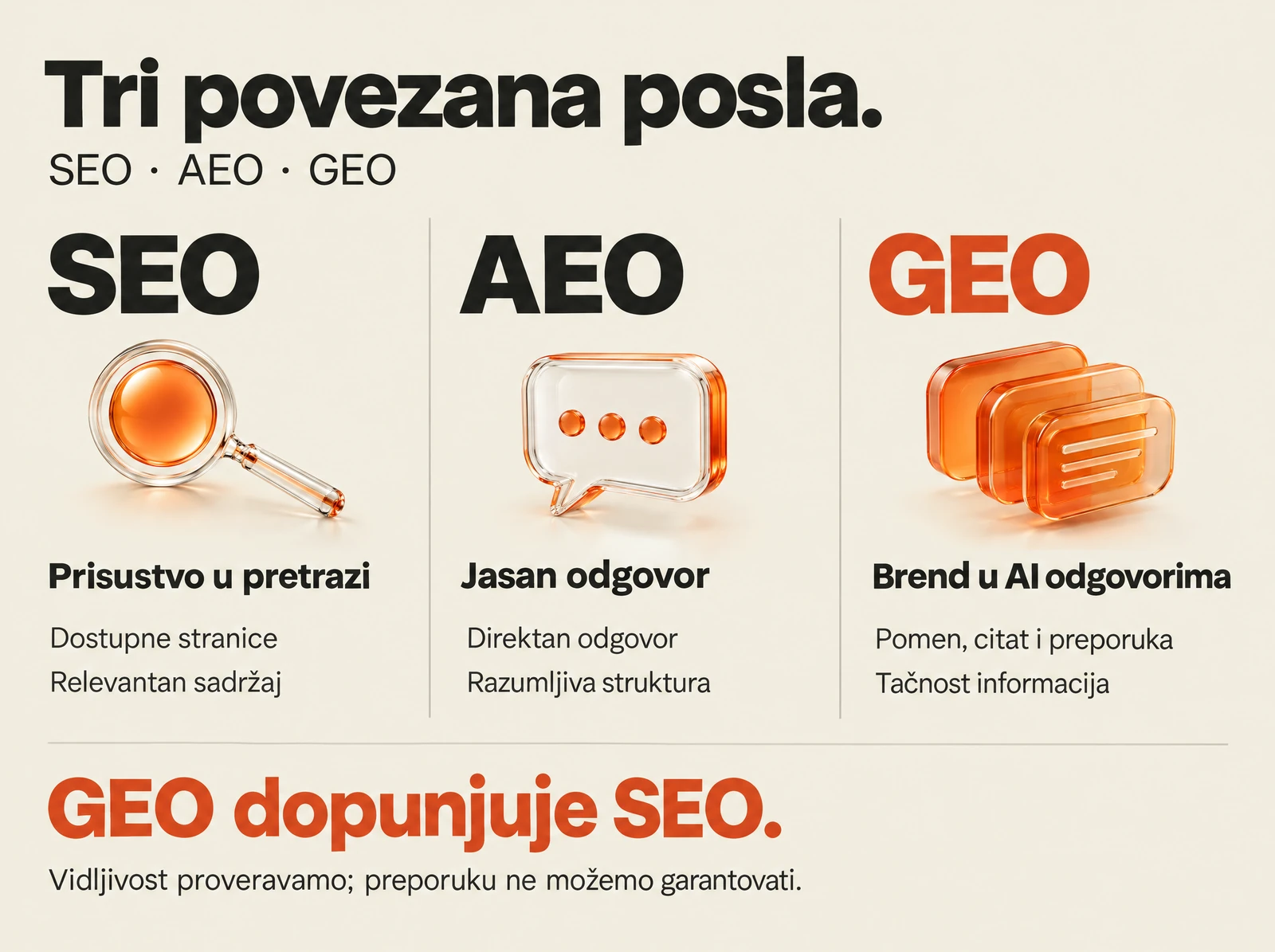
Text description of the graphic
- SEO: search presence, accessible pages and relevant content.
- AEO: clear, direct answers and understandable structure.
- GEO: the brand in AI answers; mentions, citations, recommendations and accuracy.
- GEO complements SEO. We verify visibility; recommendations cannot be guaranteed.
Does GEO replace SEO?
GEO work makes more sense when technical and content foundations are sound. An important page must be accessible and clearly explain the company's actual offer.
Google says existing SEO fundamentals apply to AI Overviews and AI Mode. No special AI file or schema is required. A page must be indexed and eligible for snippets, and appearance is still not guaranteed. See Google's official AI search guidance.
If a website hides its service behind vague slogans, I would improve those pages first. Another site's problem may be outdated company information in a source cited by AI. The same goal can require different first steps.
Our GEO and AI visibility page explains how we connect these tasks. SEO optimisation remains a separate discipline with its own scope and responsibilities.
Mentions, citations and recommendations carry different weight
A company name appearing in an answer is a mention. A link to your website as a source is a citation. An explicit suggestion that your company suits the described need is a recommendation in that particular answer.
I retain these distinctions in reporting. Imagine AI citing your educational article while recommending another company. Your content served as a source; that finding does not show the buyer chose you.
Another example is your name appearing with the wrong location or a service you do not offer. Mention counts look positive, but information needs correcting. Accurate brand representation would be my priority.
The AI visibility measurement guide explains calculations, sample sizes and interpretation limits.
For budgeting, see how I compare SEO fees and scope. For Google specifically, see what I would improve for AI Overviews and AI Mode.
What would I expect in a GEO agency proposal?
I would seek agreement on five things:
- Business goal. Which service, product or buyer decision are we addressing?
- Review scope. Which questions, market, language and AI systems are included?
- Specific deliverables. Which pages change, what is written and which sources are checked?
- Responsibility. Who verifies specialist information and implements technical changes?
- Measurement. How is the baseline saved, and what counts as a useful business change?
“AI optimisation” alone does not explain how many pages you receive, which information is verified or what you can compare next month. The engagement scope should.
For the initial review, see what an AI visibility audit should deliver.
Example: one company, three connected tasks
Imagine a language school offering evening business courses for working adults. This is illustrative, not a claim about a client's results.
The SEO task makes the course page accessible and connects it to search questions. The content task explains starting level, schedule, teaching method and entry criteria. The GEO check then examines the school's representation in answers about choosing such a programme.
If an answer wrongly says only private lessons are available, we check the pages and sources used. If the description is accurate but people abandon the application, we examine the journey from visit to enquiry.
That sequence matters more to me than the number of acronyms in a presentation.
Where should you start if you do not track AI visibility?
Choose one important service and record the questions people ask before they are ready to talk. Check whether the website answers accurately and fully, then examine the offer in a small, documented sample of AI answers.
If descriptions are unclear or inconsistent, start with the company information to improve first for AI search.
To select questions, use our guide to checking whether AI search changes the buyer journey.
To define priorities together, explore the SEO and AI audit and sample report. The introductory conversation covers goals and possible scope. My criterion is that analysis leaves you with an actionable decision.
Questions to resolve before working together
Should I start with SEO or GEO?
The initial review should identify the obstacle. Inaccessible pages or unclear offers take priority. With sound foundations, you can immediately check AI answers, content gaps and sources more systematically.
Does one ChatGPT answer prove success?
One saved answer is an individual finding. Tracking change needs the same questions, recorded conditions and repeated checks. Business success also needs enquiry and sales evidence.
Can a GEO agency guarantee a recommendation?
An agency can contract for analysis, changes, content and verification. Systems shape the answers themselves. Assess proposals by clear deliverables, evidence quality and responsibility for work.