

An AI visibility audit documents how your brand, website and offer appear in answers from selected AI systems. A useful audit connects buyer questions, sources and observed problems to priorities someone can implement.
My criterion is simple: after reading, you should know what to change first, why and how to verify whether it helped. A polished mention overview can be part of the report. Deciding the next step is the reason to invest.
Below is the initial scope I would seek. It is a proposed methodology; the final number of questions, pages and systems depends on the business.
For terminology and deliverables, read how I distinguish SEO, AEO and GEO.
An audit begins implementation. The ChatGPT optimisation process guide explains turning findings into technical tasks, content and business-enquiry measurement.
I connect AI checks with an SEO analysis of technical foundations, content and intent. That guide includes findings with evidence, owners and acceptance criteria for implementation planning.
From business goal to test questions
Limit the audit to a clear market, language and offer. “We want more AI visibility” becomes actionable when the service and potential clients are defined.
An initial panel should cover understanding the problem, comparing solutions, choosing suppliers and checking a specific brand. Keep branded questions separate. “What does our company do?” tests something different from discovering the company without its name.
| Business | Illustrative buyer question | Information that should be clear |
|---|---|---|
| Private clinic | How do I compare practices providing a particular examination? | Service, clinical team, location and booking |
| Online store | Which model suits my use, and what are the return terms? | Specifications, limitations and purchase terms |
| B2B or SaaS company | Which supplier supports our process and required integration? | Use cases, integrations, scope and responsibility |
| Real estate agency | Who can organise a search and viewings in a particular area? | Coverage, service and next step |
| Finance and insurance | What should I compare before discussing an individual offer? | Public terms, limitations and contact for a personalised proposal |
| Hotel | Does this accommodation suit a family with particular needs? | Facilities, location, limitations and booking |
| Education | Which programme fits my starting knowledge and schedule? | Entry requirements, curriculum, dates and teaching method |
These illustrate panel design, not completed tests. Adapt questions to your offer and anonymised sales themes. More in the article about AI search and the buyer journey.
What exactly do we record with each answer?
Without test conditions, later changes are difficult to interpret. For each attempt, I would record:
- question ID and exact wording;
- platform, available model or mode label and whether web search is enabled;
- date, time, language and known geographic context;
- whether the conversation is new and relevant personalisation exists;
- the complete answer, cited sources and repetition count;
- brand mentions, domain links, recommendations and inaccuracies.
Record unknown information as “unknown”. Do not infer location from interface language or invent a model name when the platform does not show it.
Repeat according to an agreed procedure for a comparable sample. Results still do not represent every user or market share.
Rates and repetition rules are explained in the AI visibility measurement guide.
Checking the website and crawler access
I examine the AI answer alongside the page meant to explain the offer. Does it work, display main content, connect through internal links and contain consistent company information?
Read access rules per platform. OpenAI distinguishes search-oriented OAI-SearchBot from training-related GPTBot, with separate permissions. See the official crawler documentation.
Perplexity documents PerplexityBot's role and checks through robots.txt and website protection. The review must therefore include server response, not just one file.
I give such findings to the website owner. Access changes must follow the owner's actual policies and be verified after implementation.
If llms.txt appears in recommendations, ask which tool and task it helps. See when llms.txt makes sense for the difference between a supporting file and evidence of AI visibility.
What does an actionable finding look like?
Each important finding should contain evidence, a business consequence, a proposed change, an owner and acceptance criteria.
The following example is demonstrative:
| Field | Example finding |
|---|---|
| Observation | Two of three saved answers describe the company as providing only one service |
| Evidence | Question ID, answers and the specific source using an outdated description |
| Business relevance | An important second service is absent from that sample |
| Proposed work | Expand the relevant page and request correction of an outdated public profile |
| Responsibility | The specialist team confirms the description; editor and administrator implement it |
| Verification | Check published information and repeat the same panel with a new date |
A website change does not guarantee the next AI answer will change. It provides a verifiable intervention whose subsequent effect can be observed.
For inaccurate or incomplete brand descriptions, use the sequence for improving company information for AI search.
What should the final audit deliver?
I would seek a baseline, check records, important gaps and an ordered task list. Each task needs an estimate and dependencies on your team.
I would prioritise as follows:
- Accuracy and accessibility first. Wrong locations, inaccessible pages and outdated services can confuse potential clients.
- Information needed to choose next. Who does the service suit, what is included and how does collaboration start?
- Then additional content and sources. Where is a guide, comparison or verifiable example needed to support the decision?
The plan must explain what was not checked. Without analytics access, an audit can describe content and an answer sample well. Sales conclusions need other data.
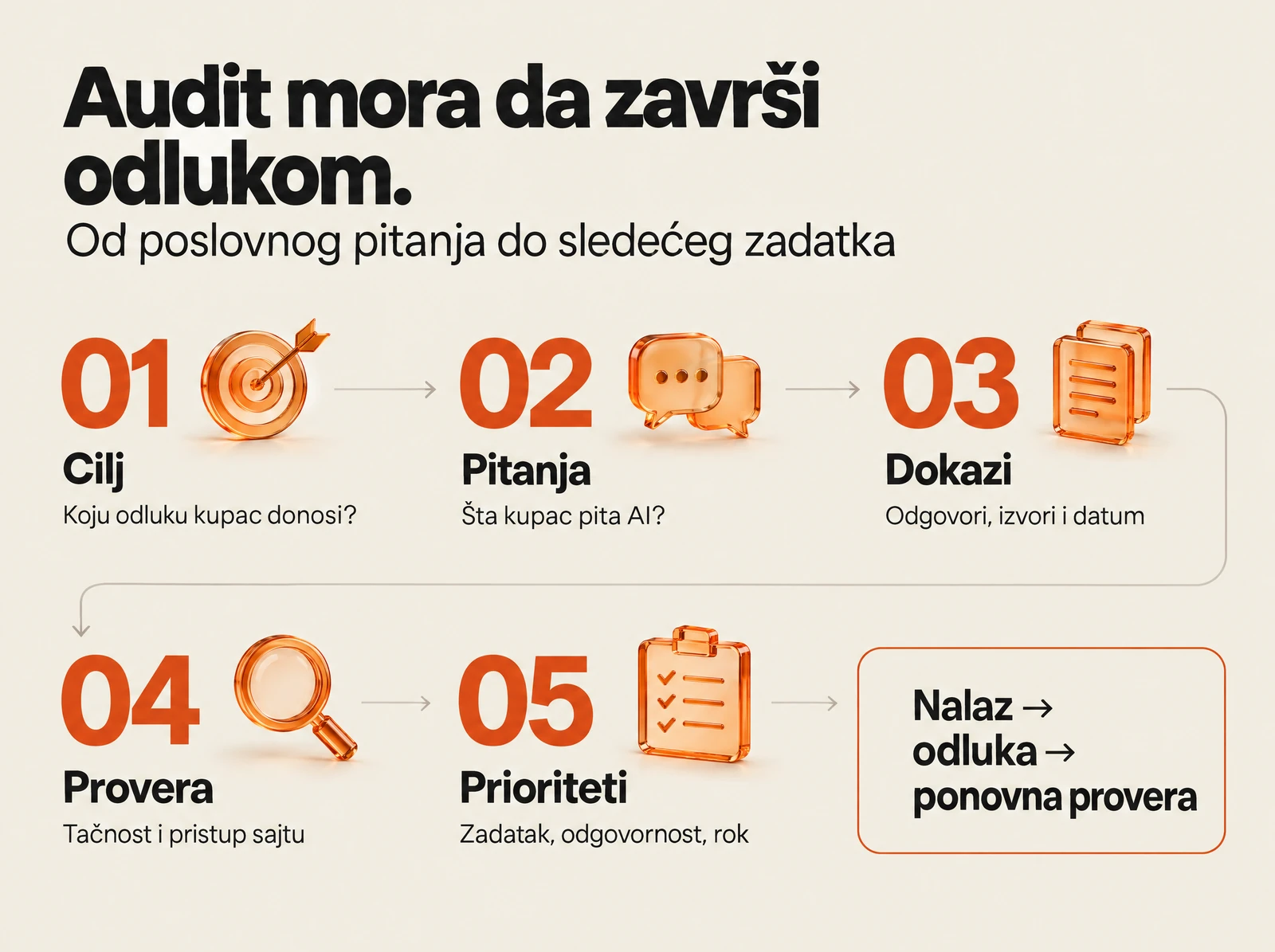
Text description of the graphic
- 1. Goal: what decision is the buyer making?
- 2. Questions: what does the buyer ask AI?
- 3. Evidence: answers, sources and date.
- 4. Verification: accuracy and website access.
- 5. Priorities: task, owner and deadline.
- Finding → decision → repeat check.
How long does it take, and what determines the price?
Timing depends on markets, languages, priority services, questions and systems. Agree on repetitions, specialist verification and whether implementation is included.
Explore the current scope of Sygnific's SEO and AI audit. The sample audit shows findings connected to priorities. The final proposal should fit your domain and market.
When does an audit make business sense?
When there is an important service, a clear audience and capacity to implement findings. It is particularly useful when company information differs across the website and public sources or before a larger content investment.
If the offer is still being defined, first clarify what you sell and to whom. An initial conversation is then more useful than a large question panel without a clear goal.
Explore our GEO optimisation and AI visibility approach or discuss your brand. I recommend starting with one important buyer decision and checking how well your information helps today.