

A website SEO analysis checks technical access, indexing, content, search intent, internal links and relevant external signals, turning findings into an improvement plan. A commercially useful analysis identifies pages that can attract potential clients, obstacles and how changes will be assessed.
For me, analysis is complete when the owner can say: I understand what we change first, why, who is responsible and what we will check afterwards. Hundreds of exported warnings without that explanation can become a document everyone owns and nobody uses.
At Sygnific, we connect SEO analysis to GEO/AEO visibility and the enquiry journey. Being found and represented accurately matters, as does helping visitors understand the offer. Ranking for the wrong topic, citations without useful context and unsuitable visits differ from qualified business enquiries.
This guide covers organisation from business goals and evidence to findings and a 90-day plan. It is for owners, marketing teams and people hiring agencies. Findings and figures are illustrative, not client results.
What should SEO analysis answer for your business?
I start with five questions. Which products or services need more relevant enquiries? How do buyers search? Which pages should participate? What obstacles appear in data and on the site? Which recommendations can the company implement?
Answers define scope. Ten service pages differ from thousands of products and filter combinations. A six-month B2B sales cycle cannot value an article solely by same-session purchases. Healthcare and finance require particularly careful expert review.
I distinguish three deliverables: analysis establishes condition and priorities; strategy sets direction and resources; implementation changes code, content and structure. Contracts should say which are included. An audit does not automatically include all fixes.
SEO audit and SEO analysis often overlap in practice. The name matters less than agreed scope, evidence and actionable recommendations.
When is website analysis worthwhile?
- Before major SEO/GEO investment: separate real obstacles from appealing activities.
- When visits decline: identify affected pages, queries and periods before concluding.
- When visits do not produce enquiries: connect intent, content, offer and conversion.
- Before a site or platform change: preserve URLs, content, measurement and redirects.
- When entering a market or expanding a catalogue: adapt structure to buyer needs.
- When seeking AI visibility: first establish accessibility, clarity and support, then measure relevant answers.
I would not order a full audit for every ranking fluctuation. Check change size, comparable periods, seasonality, website changes and measurement reliability first. Sometimes a focused review suffices; sometimes broader work is needed.
What data is needed before starting?
A public review reveals server status, visible content, titles, links, images, structure and some technical signals. It cannot reliably reveal all Google impressions, actual conversions or sales rejection reasons.
On smaller screens, scroll the table horizontally.
| Source | What I check | Important limitation |
|---|---|---|
| Public website and crawl | URLs, server responses, content and internal links | Sample and crawl settings affect coverage |
| Google Search Console | Queries, pages, clicks, impressions and URL status | Not all queries appear; average position is not a fixed position for everyone |
| Web analytics | Entry pages, events and contact journeys | Results depend on setup, consent and available data |
| CRM / sales records | Enquiry quality and sales outcomes | Unknown sources and incomplete statuses must remain visible |
| Ahrefs / DataForSEO and similar tools | Demand estimates, competition and external links | Estimates are not your analytics; missing metrics need not mean zero demand |
Record sources and periods before work. Comparing January with December, desktop with all devices or global volume with Serbia can create a misleading story. Missing access means labelling findings as observations or hypotheses, not confirmed causes.
I would request the domain, priority services or categories, market, actual buyer questions, business goal and important site changes. Grant access through account permissions with minimum necessary scope. Do not send passwords or customer personal data through contact forms.
What does the SEO analysis process look like?
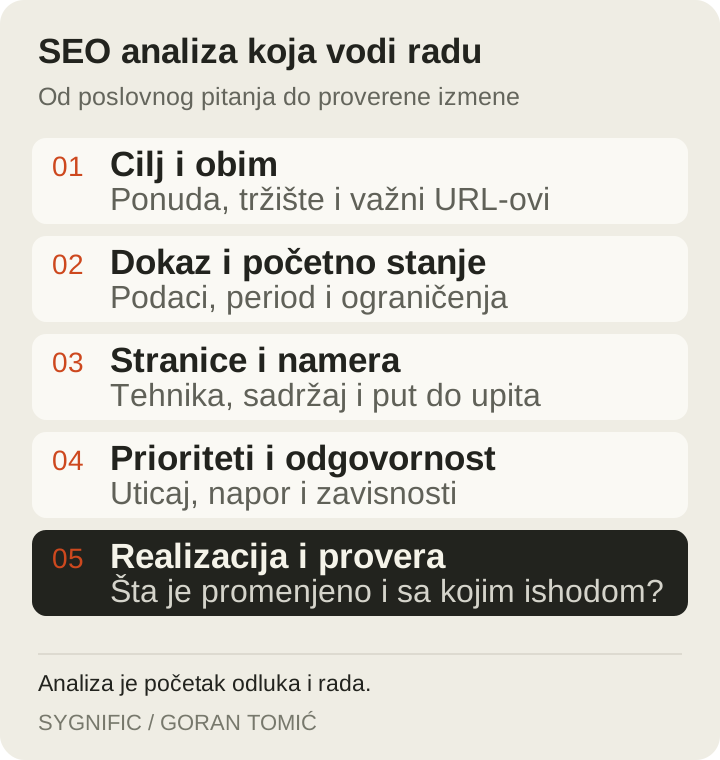
- Agree on goals and scope: outcomes and pages covered.
- Establish a baseline: sources, period, change history and qualified-enquiry definition.
- Technical checks: accessibility, indexing, canonical, redirects, rendering and user experience.
- Demand and content: intent, destination URL, answer coverage and expertise evidence.
- Structure and sources: internal links, external signals and company information.
- SEO/GEO and sales priorities: impact, evidence, effort and dependencies.
- Implementation and checks: owner, expected change and completion criteria.
Tools accelerate collection; conclusions need verification. A missing meta description is visible, but an inaccessible priority service page probably comes first. Warning counts are not business priorities.
Technical SEO: can important pages be found?
Accessibility and indexing are different
First check expected content and status, then indexability and Search Console status where available. HTTP 200 does not automatically mean indexed. A sitemap entry does not prove Google displays it.
URL Inspection shows Google's URL information and live-test results. Distinguish index state from live tests: access today does not mean Google has processed the new version. Record exactly what was checked and when.
Robots, noindex and canonical
robots.txt governs crawler access; noindex instructs indexing. They are not interchangeable. If crawling is blocked, do not assume Google read a page's noindex. See Google's robots.txt limitations.
Canonical identifies the preferred content version. Check consistency with links, redirects and sitemaps. It is neither a universal fix for similar pages nor a guarantee Google chooses that URL. Content and other signals matter. See the duplicate-URL consolidation guide.
Redirects, errors and migrations
URL changes need an explained old-to-new map. Do not blindly redirect all removed products or articles to the homepage. Check for meaningful replacements, shorter redirect chains and internal links directly to final destinations.
Distinguish an isolated minor error from a template fault affecting a catalogue. Show coverage. “Seven broken links” says less than “the main proposal link fails on every service page”.
JavaScript, mobile and speed
Check rendered content as well as raw server responses. Important text, navigation and links should be accessible. If something appears only in a browser, establish whether it comes from the website or an extension. Do not change production code to mask a browser add-on.
On phones, review headings, guide content, tables, diagrams, CTAs and forms. Use lab speed scores diagnostically alongside available real-user data. Not every recommendation warrants expensive development without assessing impact. PageSpeed Insights is a starting point.
Keywords and intent: are we attracting the right people?
Demand matters when it fits the offer. High-volume phrases may attract students, tool-login searches or buyers of products you do not sell. After metrics, inspect actual results and what Google offers.
Distinguish informational intent, comparisons, commercial research and direct service needs. Intent defines page type. A guide explains SEO analysis; the audit service page explains Sygnific's deliverables and scope. Shared topics do not automatically mean shared intent.
Map primary intent to a main URL and supporting pages. Improve an existing good guide before creating three near-identical articles for word-order variants. When URLs alternate for one intent, investigate conflict versus legitimate differences.
In Search Console, examine query-page combinations rather than site totals. Second- or third-page rankings may offer opportunities, but small impression samples need caution. Review content and results before claiming “quick wins”. Tool volume and difficulty estimates support decisions rather than replace them.
Content analysis: what does the page lack for a buyer decision?
Check whether the headline and first paragraph answer the visit's purpose, then assess scope, suitability, limitations, terms, process, examples and next steps. Keyword repetition does not measure usefulness.
Informational pages should provide independent, actionable answers; sales pages should clarify the offer and engagement. Tables should aid comparison and FAQs resolve real concerns. Generic expansion merely delays answers.
How do I check titles, descriptions and structure?
Titles should explain the topic and reason to choose the page; descriptions should accurately preview content. Section headings help readers find answers. Check that result promises match content instead of mechanically inserting keywords.
What demonstrates expertise?
An author name is insufficient for interchangeable content. Seek an explained method, concrete decision, original example or actual sourced data with limitations. Relevant specialists should review technical material; do not invent review credentials in a byline.
How do I use semantic tools and WDF*IDF?
They help identify missed topics or terms. The comparison corpus must match intent: mixing price lists, tutorials and unrelated pages distorts conclusions. No universal repetition count turns weak copy into the best result.
I do not add irrelevant terms for scores. Can a potential client make a better decision and understand the work after reading? See the broader Google SEO Starter Guide.
Internal links and external sources
Internal links connect buyer questions to useful next answers. This article naturally leads to report examples, SEO pricing and audit services. Every paragraph need not link to the same service with identical anchors.
Check meaningful routes from navigation, related articles and categories. Identify orphan URLs known from CMS or sitemaps but lacking useful incoming links. Large catalogues need sound category, subcategory and product relationships.
For external links, consider context and relevance. One tool's authority metric is not Google's company score. Counts without origins and relevance are insufficient. I would not recommend bulk buying or removal merely because a tool flags links.
Citations should link directly to supporting sources. External links are not paragraph decorations. Before removing, merging or redirecting a page, review incoming links to avoid losing useful journeys.
How do I include GEO/AEO and AI visibility?
SEO analysis provides foundations but does not establish how ChatGPT, Gemini or others represent the brand. Use a separate question panel reflecting buyer decisions: supplier choice, comparisons, industry suitability, collaboration and reliability.
Record platform, date, language, market context, search mode and the complete answer. Separate mentions, website citations, accuracy and relevant recommendations. One answer is not a stable AI ranking.
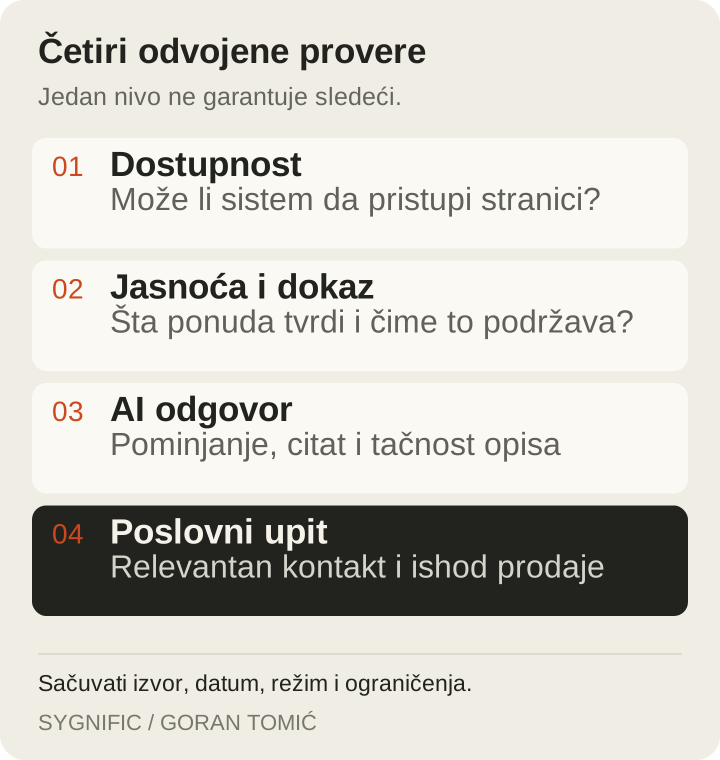
Google AI Overviews and AI Mode follow basic SEO practices. No special mandatory AI file or schema is required. Pages need eligibility, which does not guarantee appearance. See official AI-feature documentation.
Check JSON-LD against actual visible content: organisation, author, article, product or another suitable entity. Do not add nonexistent ratings or services. Structured data helps understanding, but valid syntax does not guarantee rich results or AI citations.
See ChatGPT optimisation, AI visibility audits and measuring AI visibility and business enquiries. Connect these checks without equating every citation increase to sales success.
Three actionable SEO report findings
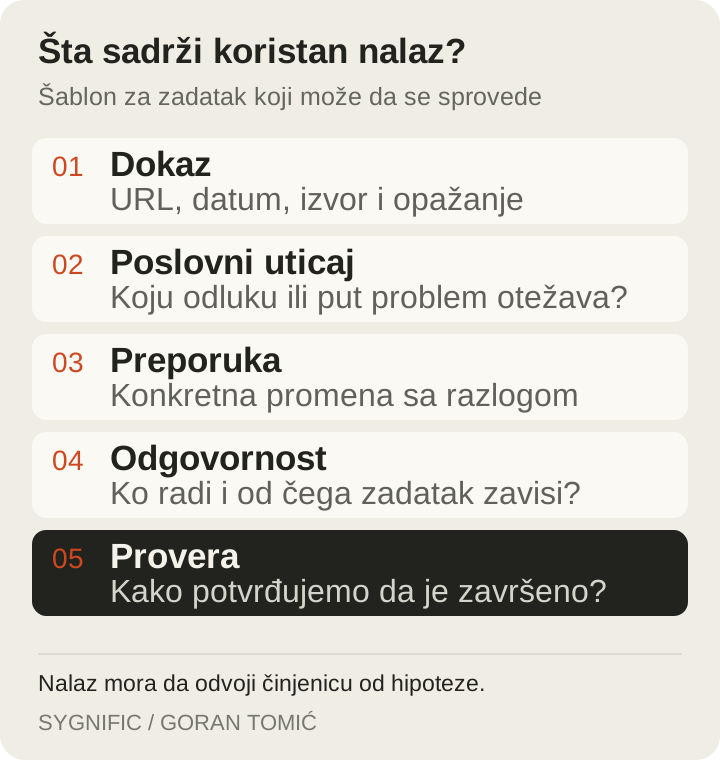
The examples below are invented to demonstrate format. Each includes an observation, required evidence, recommendation and completion criterion. Real audits add the URL, date and documented source.
Example 1: an important page has noindex
Observation: a priority service page returns 200 but contains noindex. Risk: a page intended for organic search sends the opposite instruction. Checks: establish that it is not intentionally private or duplicate, then review raw and rendered responses and URL Inspection.
Recommendation: with confirmed business intent, remove the unintended instruction and check canonical, links and sitemap. Owner: development. Technical completion: the public response no longer contains the obstacle and verification is saved. Follow-up: Google's processing status. A fix does not promise immediate indexing.
Example 2: a guide attracts the wrong audience
Observation: a business-service article mainly attracts education or employment queries. Evidence: GSC query-URL pairs, results review and contact records. Hypothesis: headline and content emphasise the wrong need.
Recommendation: clarify audience, add a business scenario and connect the right offer. If the topic is fundamentally unsuitable, consider another direction. Owners: editor and specialist. Verification: relevant queries and visit quality over a comparable period, not two days.
Example 3: organic visits lack a clear next step
Observation: a useful article promises “download a report” but leads to generic contact. Risk: unmet expectations. Recommendation: provide a real document and destination or use an honest invitation to talk.
Owners: content and development. Checks: the click delivers its promise, the destination works on mobile, the event is correctly named and contact recorded. Business review: enquiry quality, beyond button clicks.
How do I choose what to fix first?
Assess business impact, evidence strength, effort and dependencies. A quick task may be unimportant; an important one may depend on measurement repair. Make this visible.
On smaller screens, scroll the table horizontally.
| Level | When I use it | Illustration |
|---|---|---|
| P1 | A confirmed obstacle on an important business journey | Unintended noindex or a broken priority-service form |
| P2 | A reasonable opportunity with functioning foundations | Improve a relevant guide and offer links |
| P3 | Lower impact, weaker evidence or dependencies | Minor-page improvements while the main offer remains unclear |
P1/P2/P3 manage work; they are not Google ranking signals. Assigning a high priority does not guarantee revenue.
Major changes need a preservation plan. URLs, deleted text and template edits can affect other pages. Verify representative existing pages and document changes.
A plan for the first 90 days
This is an implementation framework adapted to findings and team capacity, not a promise of rankings in 90 days. Decision quality matters more than task count.

First 30 days: foundations and confirmed obstacles
Confirm measurement, responsibilities and key-page condition. Resolve access and enquiry obstacles. Map intents and URLs, recording what stays, expands or may merge.
By day 60: content supporting the offer
Improve priority service or category pages, buyer answers and internal links. Review editorial, technical and visual quality. AI work uses the same agreed question panel for meaningful comparison.
By day 90: review and adjust
Assess Google's processing, relevant queries and post-visit behaviour. Without impressions, check status and intent first. With visits but few qualified enquiries, review the offer and CRO. Findings define the next cycle, not a fixed publishing quota.
What changes by industry?
Ecommerce: categories, products, filters, variants, duplication, stock and ordering. Do not index all filter combinations without assessing value. AI work needs accurate product information; see the AI shopping guide.
B2B and SaaS: clear use cases, suitability, integrations, collaboration and evidence approved for public use. Organic contribution may precede contracts substantially, so assess opportunity quality.
Healthcare: service clarity, authorship and specialist responsibility, locations, contacts and booking. Do not invent medical promises or use patient information as marketing evidence without appropriate grounds and permissions.
Real estate, travel and education: current offers, locations, terms, availability and next steps. Expired listings, courses or property information can attract visits while wasting sales time.
Finance and insurance: precise terms, limitations and responsible expert review. More traffic is unhelpful if content creates wrong expectations. All industries share one question: what must a potential client understand to decide?
What do you receive, and what determines timing and price?
Fees depend on website scope, markets, technology, data access and depth. An automated scan differs from a manual audit with examples, recommendations and a presentation. Define work before pricing.
Our SEO and AI visibility audit starts with one brand and domain, one market and language, up to five priority services or product groups, three relevant competitors and an initial panel of up to 20 AI questions. We confirm scope and proposal before starting. Proposed delivery is ten working days after agreed information and access arrive.
- A documented baseline, sources and data limitations.
- Findings tied to pages and business problems.
- Priorities, recommendations, dependencies and verification.
- A 90-day plan adapted to your resources.
- A findings presentation and discussion of continued work.
Implementation, development, content production and campaigns are agreed separately. I offer clear scope, delivery responsibility and a quality-verification method, without guaranteed top rankings or AI recommendations. See what determines SEO pricing.
How do you assess the benefit?
First, implementation: were agreed obstacles removed and verified? Second, visibility: are priority pages processed and receiving relevant impressions and visits? Third, business outcomes: do suitable enquiries arrive, and what happens next?
Save intervention dates, affected URLs, baselines and other changes. If prices, offers, ads and the site changed together, do not credit all growth to one SEO activity. Small samples and unknown sources remain documented.
For companies investing in marketing, consider Google Ads and enquiry quality, organic search and website conversions together. See measuring whether marketing brings customers.
Website SEO analysis questions
Can a free SEO analysis be useful?
As an initial signal or limited review, yes. Know what was actually checked. Automated scores do not replace buyer-intent, offer, enquiry and implementation-priority assessment.
Does analysis include fixes?
Only if contracted. Sygnific audits provide diagnosis, priorities and a plan; implementation follows findings and resources. Your own team can use the document.
Can analysis explain why I am not first on Google?
It can reveal obstacles, intent mismatches and relevant differences from current results. It cannot reconstruct Google's whole algorithm or guarantee a position after a change.
Does SEO analysis cover ChatGPT and other AI systems?
Not necessarily. We explicitly agree on the GEO/AEO layer: questions, systems, sample, records and limits. A technical SEO review alone does not establish AI visibility.
How often should analysis be repeated?
Major changes, declining relevant signals and offer expansion justify reassessment. Between them, monitor agreed indicators and changes rather than continuously producing the same report.
Does a small website have enough data?
It may lack statistical power, but offer, access, intent, structure and contact paths can still be checked. Separate confirmed technical findings from hypotheses.
How do we start?
Send your domain, market and priority service. The introductory conversation clarifies goals and audit suitability. Then we confirm scope, price, access and timing.
Author: Goran Tomić. Published and sources checked 12 October 2026. Illustrations and findings demonstrate the method, not a particular client's results. Official documentation supports the associated claims.