

Local SEO helps a company be found for a service where it actually operates. It includes Google Business Profile, the website, locations, reviews and other relevant sources. I would aim for more suitable contacts, bookings or visits, with clear source tracking.
People seeking a repair service, clinic, school or accommodation often need specific answers: are you nearby, do you provide this service and how can they contact you? I first remove uncertainty from that journey, then discuss broader content.
What determines local rankings?
Google names relevance, distance and prominence as the main factors. Complete information helps explain the offer; user location affects distance; reviews and other websites contribute to prominence. See Google's local-ranking explanation.
I check results for the company's actual market. Searching from one office does not prove equal visibility to everyone in a city. Record the query, location and date and assess findings alongside contact data.
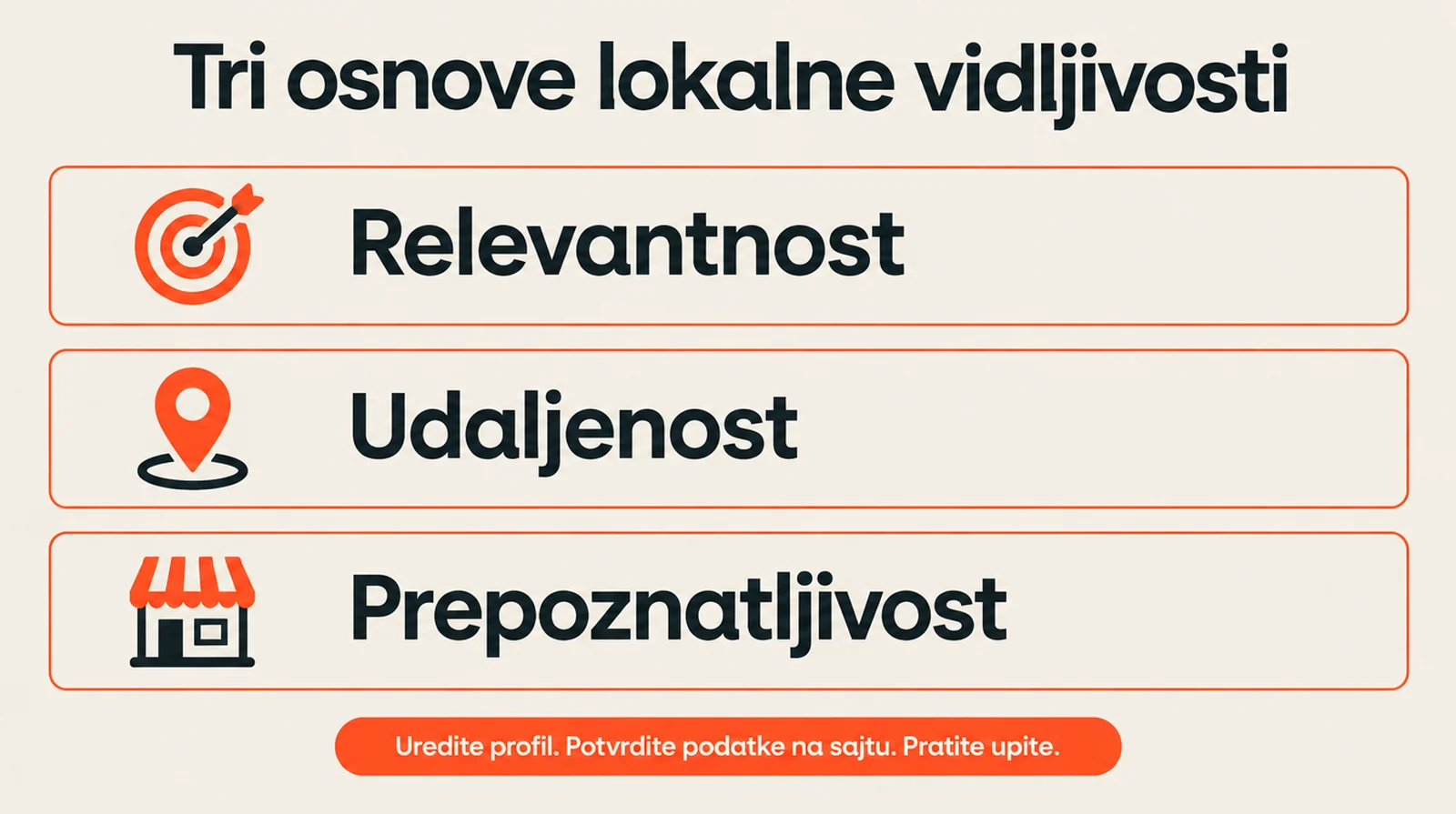
Text description of the graphic
- Relevance
- Distance
- Prominence
- Improve the profile. Confirm website information. Track enquiries.
What do I check first on Google Business Profile?
Google Business Profile, formerly Google My Business, is a starting point when the business is eligible. I check ownership, access, actual name, main category, hours, phone, address or service area and destination link.
I would not add ranking keywords to the name or use a fictitious address. Google's business representation rules define name, location and eligibility requirements. A purely online business without in-person contact should not automatically receive a local profile.
A business visiting customers without receiving them at its address should configure its service area and hide the address under profile rules. Hybrid businesses receiving clients have different conditions; do not hide or show addresses automatically.
The owner should retain profile control and give collaborators appropriate roles, so changing agencies does not become an access problem.
Choose photos that answer real questions: entrance, premises or what buyers receive. Check holiday hours. A better-looking profile cannot fix a phone nobody answers.
How do I choose local keywords?
Start with the actual service and service area, then examine search results. Queries may seek Maps locations, prices, appointments or comparisons. These intents need different answers even with the same city name.
In an illustrative school plan, distinguish “language school Zvezdara” from “evening business English classes”. One seeks a local choice; the other a programme condition. Hotel location and parking needs provide a similar distinction. Confirm topics through conversations and search data.
I would not write a separate article for every word order. If two phrases describe the same offer and decision, one complete page is often clearer. Social media can add information but should confirm the same terms and contact details.
How do I connect the profile with website pages?
The profile link should lead to a page confirming that location's offer. For one location, a strong company page may suffice. Multiple genuine locations often merit separate pages with genuinely different information.
| Page information | What it clarifies |
|---|---|
| Services at the location | Can the buyer get what they need? |
| Exact address, directions and hours | Where and when can they visit? |
| Team, process and terms | Who provides the service, and how does it work? |
| Location-specific contact | What is the next step? |
I would not create ten near-identical pages by changing city names. Each page needs a real reason: availability, logistics, local staff, terms or a relevant example. Google's doorway-abuse policy warns about pages targeting similar queries and funnelling to one destination.
Reviews: authentic experience and useful responses
After service completion, give clients the option to leave an honest review, consistently across eligible clients. No purchased ratings, rewards, incentives or filtering out unhappy clients. These practices are covered by Google's fake-engagement rules.
A response should show understanding. Answer criticism calmly, offer a concrete resolution and protect private information. Healthcare responses should not confirm treatment details.
There is no universal target review count. I consider relevance, continuity, content and how the company resolves repeated concerns.
Where do local SEO and GEO meet?
“Who provides this nearby, and on what terms?” can also arise in AI conversations. Align public information across website, profile and relevant sources. Our company information for AI search guide explains the sequence.
Accuracy is an obligation to buyers and useful GEO work. Consistency alone does not guarantee recommendations. In an AI visibility audit, check questions producing mentions, cited sources and whether descriptions match the service.
Imagine a language school with two locations and different evening schedules. Pages distinguishing schedules, levels and contacts help people choose. An incorrect AI schedule gives a specific source-checking task rather than “do more GEO”. This is illustrative, not a client result.
How do I measure whether local SEO brings business?
Separate profile interactions, website visits, received contacts and qualified enquiries. A phone click does not confirm a conversation; directions do not prove a purchase. Connect these useful signals to business records.
Use consistent UTM tags for website links. Record location, requested service, outcome and source where known. Call and user tracking must respect applicable privacy obligations; choose technology around the actual need.
My first plan: fix access and information, connect the right page, test mobile contact, establish a review process and record baseline results. This fits SEO work; measurement decisions fit analytics and attribution.
Local SEO questions
Does local SEO make sense if we operate across Serbia?
It can, with real locations or locally relevant services. National acquisition also needs service pages answering a broader market.
Is a Google profile enough without a website?
A profile can be an important contact point. A website explains services, terms and location differences in depth. Set priorities by what buyers lack for their decision.
Does paying for ads improve local organic rankings?
Google says better local positions cannot be bought. Assess advertising as a separate channel through budget and enquiry quality.