

Google ads are paid placements reaching people searching, watching or considering offers across Google channels and partner surfaces. Business results require a relevant audience, an appropriate ad, a good landing page and reliable enquiry or purchase measurement.
When assessing Google Ads, my first question is: which business do we want to win, and what is winning it worth? Keywords, clicks and budget follow. Reversing the order can produce tidy reports and campaigns disconnected from sales.
At Sygnific, advertising connects to SEO, GEO/AEO and conversion optimisation. Each has a role. Google Ads reaches relevant audiences and tests offers; organic and AI visibility build presence through content and sources; CRO improves the visit-to-enquiry journey. Buying ads does not buy organic rankings or AI recommendations.
This guide is for owners, marketing managers and budget decision makers. I explain campaign setup, reporting and when to stop increasing spend. All numerical calculations are illustrative, not client results or campaign forecasts.
What are Google ads, and how do they differ from SEO?
Google Ads is an advertising platform. PPC, or pay per click, is one billing model; the terms are not synonyms. Buying and optimisation depend on campaign type and strategy. This article focuses mainly on search ads because their connection to an expressed need is easiest to explain.
When someone searches for a supplier, service or product, an ad can connect that query to your offer. SEO develops the relevant page's organic discoverability. GEO/AEO extends work to the accessibility, clarity and reliability of information AI systems can use.
Not every channel must run simultaneously. A company with demand and a good site can begin a controlled ad test. An unclear service, broken form or nobody receiving enquiries should be addressed first. See SEO or Google Ads: choosing the first channel.
When does Google advertising make business sense?
I look for four conditions: a relevant audience, an explainable offer, capacity to deliver promises and acceptable acquisition economics. Any missing condition becomes pre-launch work or a test limitation.
- Service company: sales can respond quickly and defines a good enquiry.
- Online store: prices, stock, delivery and product information match the ad.
- B2B company: campaigns connect to a longer sales process; demos and forms are not automatically revenue.
- Local business: targeting and service availability match capacity.
I care less about potential click counts than, “If ten good enquiries arrive tomorrow, who receives them and what happens?” Campaigns cannot compensate for unanswered calls, inaccurate availability or an incomprehensible offer.
Which campaign type should you choose?
I select types by task and input-data quality. More channels do not inherently make a strategy advanced. An initial test should be focused enough to explain its result.
On smaller screens, scroll the table horizontally.
| Type | Typical task | Checks before spending |
|---|---|---|
| Search | Answer searches connected to the offer | Intent, ad, location and specific landing page |
| Shopping / catalogue campaigns | Present available products | Product data, prices, stock, feed and market support |
| Performance Max | Work towards a goal across Google channels | Conversion goals, values, assets and contribution assessment |
| Display and video | Introduce an offer and develop interest | Creative, audience relevance and contact valuation |
Formats depend on country, account and platform policies. I would not promise Shopping or specific placements before checking market support. See Google's campaign selection documentation.
Performance Max may fit when goals and data are sound. Counting every page opening as success gives automation the wrong task. Wider distribution cannot turn a poorly defined conversion into a qualified customer.
How does Google choose which ad to show?
Google uses auctions and Ad Rank to assess eligibility and position. Besides bids, quality, ad and page relevance, competition, context and expected asset impact matter. The highest bid is not the only criterion. See Google's Ad Rank guide.
The practical consequence: message, keyword and page should address the same problem. Sending a specific-service search to a homepage with six unrelated offers makes the user search again inside your site. Remove that obstacle before increasing budget.
I would not chase a quality-column score without understanding the buyer's need. Relevant headings, clearer scope and faster pages make sense when they ease decisions. Verify effects through campaign data and post-click behaviour.
Keywords: intent matters more than list size
Separate queries reflecting different decisions. “What is accounting”, “accounting agency for an IT company” and “bookkeeping jobs” share words but need different answers. An accounting service should not value all those contacts equally.
Start with service or product, the problem solved, comparisons and prices, and branded searches. Check results, user expectations and available pages for each. See the website SEO analysis guide for research and existing pages.
Match types determine how broadly keywords connect to queries. “Exact” does not mean only identical characters; broader matching needs appropriate goals and controls. Follow Google's current match-type documentation.
I use search terms to assess the needs attracted. Add negatives for clear offer mismatches. “Free” may be irrelevant to one company but useful to another offering a real free trial. Rules must follow the business model.
What happens between a click and a client?
The most important work often follows the click. Visitors should recognise the offer, understand suitability, see evidence and take an easy next step. The company must then handle contact. Campaign optimisation therefore connects to sales.
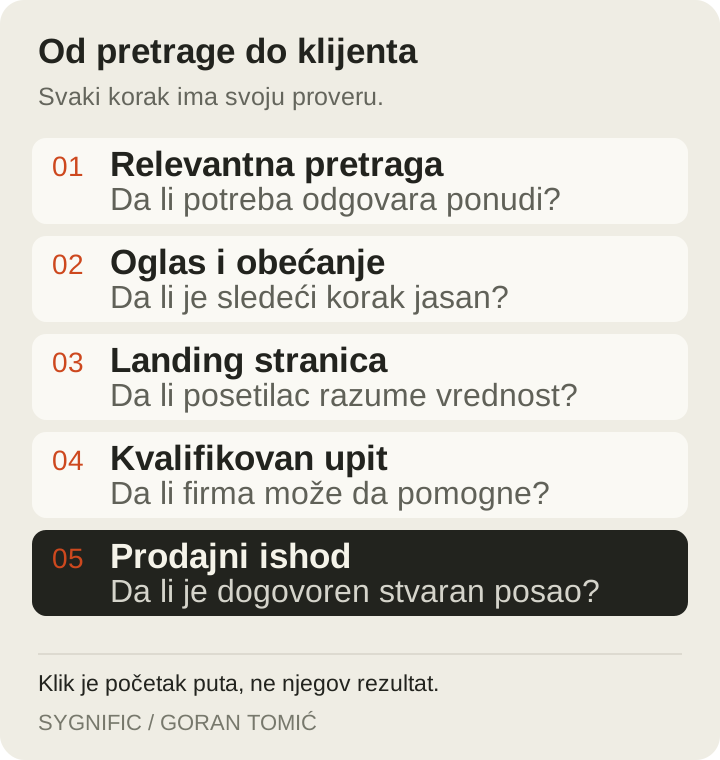
On the page, check headline, scope, suitability, evidence, what follows contact and form functionality. For complex services, discussing scope can be enough. For simple products, the next step may be a purchase. The CTA must fit the decision buyers can make now.
See landing pages that generate enquiries. Where visits exist without relevant contacts, CRO often provides a better next task than more ads.
How do you measure without flattering results?
Define conversions first. A valid form, completed purchase and meaningful call differ from a button click. Track distinct events rather than combining them into an impressive but commercially weak total.
For services, record at least received contact, qualified enquiry, proposal sent and business won or lost. Define qualification beforehand: service fit, market, real need and other relevant criteria. Sales should record rejection reasons.
For stores, verify purchases are sent once, values and currency follow the definition, and cancellations and returns are handled. A test order must not become permanent evidence of success. Tests should be controlled and recorded.
Google Ads measures valuable activities and uses conversions for optimisation. Goals must therefore fit the business, as the official conversion measurement guide explains. Tags are a start; reliability requires comparison with actual contacts and sales.
Ads, analytics and CRM may differ because of attribution, recording times, windows and missing data. Do not add platforms' reported conversions as necessarily distinct customers. Agree on each metric's source and definition. Configure data processing and consent appropriately without sending unnecessary personal or sensitive information to marketing tools.
A cheaper enquiry can mean a more expensive customer
Imagine two campaigns with €600 ad spend in comparable periods. The figures are entirely illustrative. Agency fees, production, sales work, taxes and other costs are excluded.
On smaller screens, scroll the table horizontally.
| Metric | Campaign A | Campaign B |
|---|---|---|
| Ad spend | €600 | €600 |
| Clicks | 600 | 300 |
| Average CPC | €1 | €2 |
| All enquiries | 30 | 15 |
| Ad cost per enquiry | €20 | €40 |
| Qualified enquiries | 6 | 12 |
| Won clients | 2 | 4 |
| Ad cost per client | €300 | €150 |
By clicks and form cost, A looks better. By clients and ad acquisition cost, B wins. Profit still requires contract value, margin, payment timing, delivery costs and retention.
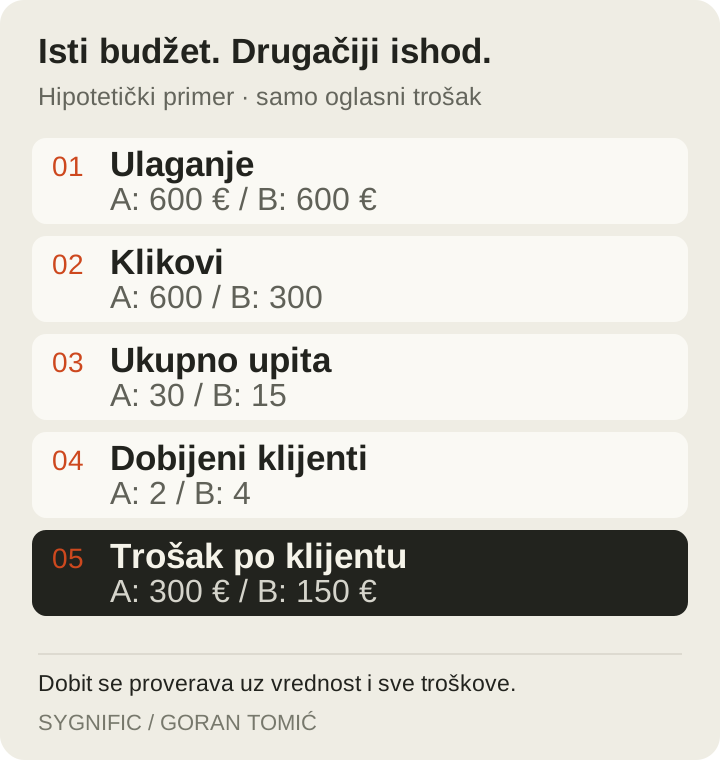
Keep formulas clear: CPC = ad spend / clicks; cost per enquiry = ad spend / enquiries; qualified-enquiry cost = ad spend / qualified enquiries. Full acquisition cost must include other costs covered by the agreed definition.
How should you set the initial budget?
Tie budget to a testable business assumption. What is a won engagement worth, what remains after delivery, what can fund acquisition, how many contacts can sales handle and how long does closing take? Without this, an amount “for Google” is arbitrary.
For the first test, limit offers and audiences. Show Google spend, campaign management, creative, page development and measurement separately. Spreading a small media budget across too many goals may yield too little evidence.
Planning example: if acceptable ad cost per client is €200 and records show one sale per five qualified enquiries, the implied qualified-enquiry ceiling is €40. This is only a model with specified assumptions. Changing closing rates or adding costs changes the threshold.
For a new account, I would not present that assumption as an expected result. Define test limits, measurements and decision points in advance. Increase budget when data and business capacity justify it.
How would I organise the first 30 days?
This is an organisational proposal, not a profitability deadline. Long sales cycles may reveal contact quality in month one but revenue later.
- Foundations: offer scope, access, account ownership, market, sales capacity and measurement.
- Preparation: intent groups, ads, landing pages, budget and controlled conversion tests.
- Launch: delivery, spend, term relevance and data verification.
- Initial quality review: sales discussion, unqualified-enquiry reasons and confirmed tracking.
- Decision: retain direction, improve the offer/page, narrow the audience or stop part of the test with a clear reason.

Record important changes rather than changing everything without a rationale. Date, change, reason and verification criteria form a short campaign log, allowing reports to explain decisions.
Why do Google ads fail to bring good enquiries?
Impressions but few clicks: check intent, message, context and competing offers. CTR alone is not a verdict; audience fit matters.
Clicks but no contacts: test mobile pages, message consistency, scope clarity, evidence, speed and forms. Check tracking against actual contacts.
Irrelevant contacts: inspect search terms, geography, offer terms and ad wording. Buyers should understand minimum engagement scope before talking.
Good enquiries but weak sales: review response times, qualification, proposal, pricing and sales cycle. Find evidence before blaming marketing or sales.
Excellent platform results but poor business economics: check duplicate events, values, attribution and actual revenue. Include store returns. A form without a sale remains an enquiry.
How does advertising complement SEO, GEO/AEO and CRO?
Campaigns reveal real buyer questions and wording. Useful insights can improve service pages, guides and pre-purchase answers. Organic data reveals existing interest. This exchanges knowledge rather than automatically transferring success between channels.
GEO/AEO needs clear offers, reliable sources and useful answers. The ChatGPT optimisation guide explains the process. Ad budgets cannot promise AI recommendations. Measure paid acquisition, organic search and available AI signals separately.
CRO connects all channels to the same website decision. If visitors cannot understand why to choose you, the problem can repeat across sources. Ads, content and pages should not be isolated deliverables.
What should an agency deliver?
Agree on scope, goals, costs and responsibility. Who prepares offers and creative, changes the website, qualifies enquiries and owns accounts? What happens when the engagement ends? Resolve these before major spending.
- Spend and results under agreed definitions.
- Enquiry quality and post-contact sales records.
- Important changes and their rationale.
- Measurement limitations, without hiding unknown outcomes.
- A next-step proposal with a reason, owner and review date.
See our Google Ads and Meta advertising and analytics and business-outcome tracking approaches. The introductory conversation defines the problem and sensible scope. Detailed management, account analysis and implementation are contracted for business needs.
Google Ads questions
Can I manage Google ads myself?
Yes, with time, offer knowledge and data-verification capacity. Complexity and the cost of mistakes determine when specialist help is useful. Launching is a smaller task than consistent relevance, measurement and economics control.
Can Google ads work without a good website?
They can bring visits, but weak destination pages obstruct useful outcomes. For website campaigns, first create one clear, functional page matching the offer and enabling contact or purchase.
How soon can I expect clients?
Ad display and winning a client are different events. Timing depends on the offer, market, approvals, budget, contact quality and sales cycle. Agree on checkpoints rather than guaranteed sales dates.
Does paying for ads improve SEO rankings?
Paid and organic results are separate. Campaign insights can improve content and offers, but buying clicks does not buy rankings. Google explains the distinction.
Is Google or Meta better?
It depends on buyer needs, the offer and test goal. Search can capture expressed intent; Meta can introduce the offer to relevant audiences. Assess business-outcome quality, not cheaper clicks alone.
What should I prepare for a Sygnific conversation?
Your website, priority service or category, market, previous investment and enquiry-recording process. Do not send passwords or client data through the form. Access is agreed separately.
Author: Goran Tomić. Sources checked and updated: 12 October 2026. Figures are illustrative. Google Ads features and format availability may change; account-specific setup is checked against official documentation.