

I choose between SEO and Google Ads based on business timing, existing demand, website condition and an acceptable cost per qualified enquiry. Google Ads can test an offer faster through paid distribution. SEO develops organic visibility through content and technical work. Both need an understandable offer and measurement connected to sales.
With a limited budget, I would not automatically split it in half. First, I want to know which decision is urgent: testing demand for a new service, making use of a season or building a steadier source of relevant visits.
What are we actually comparing?
| Criterion | SEO | Google Ads |
|---|---|---|
| Distribution | Organic results selected by search systems | Paid impressions through selected campaign types |
| Main cost | Website, content and maintenance work | Media budget, management and creative production |
| Control | We control the website and deliverables, with uncertain placement | We configure campaigns and budget within auctions and platform rules |
| Initial check | Is there relevant organic demand and a feasible plan? | Is there enough volume for a test and a clear landing page? |
| Business measure | Qualified enquiries, sales and contribution after costs | |
Google's comparison of SEO and PPC advertising distinguishes organic visibility from paid ads. It does not follow that either channel fits every company. I would assess the service, market and available capacity.
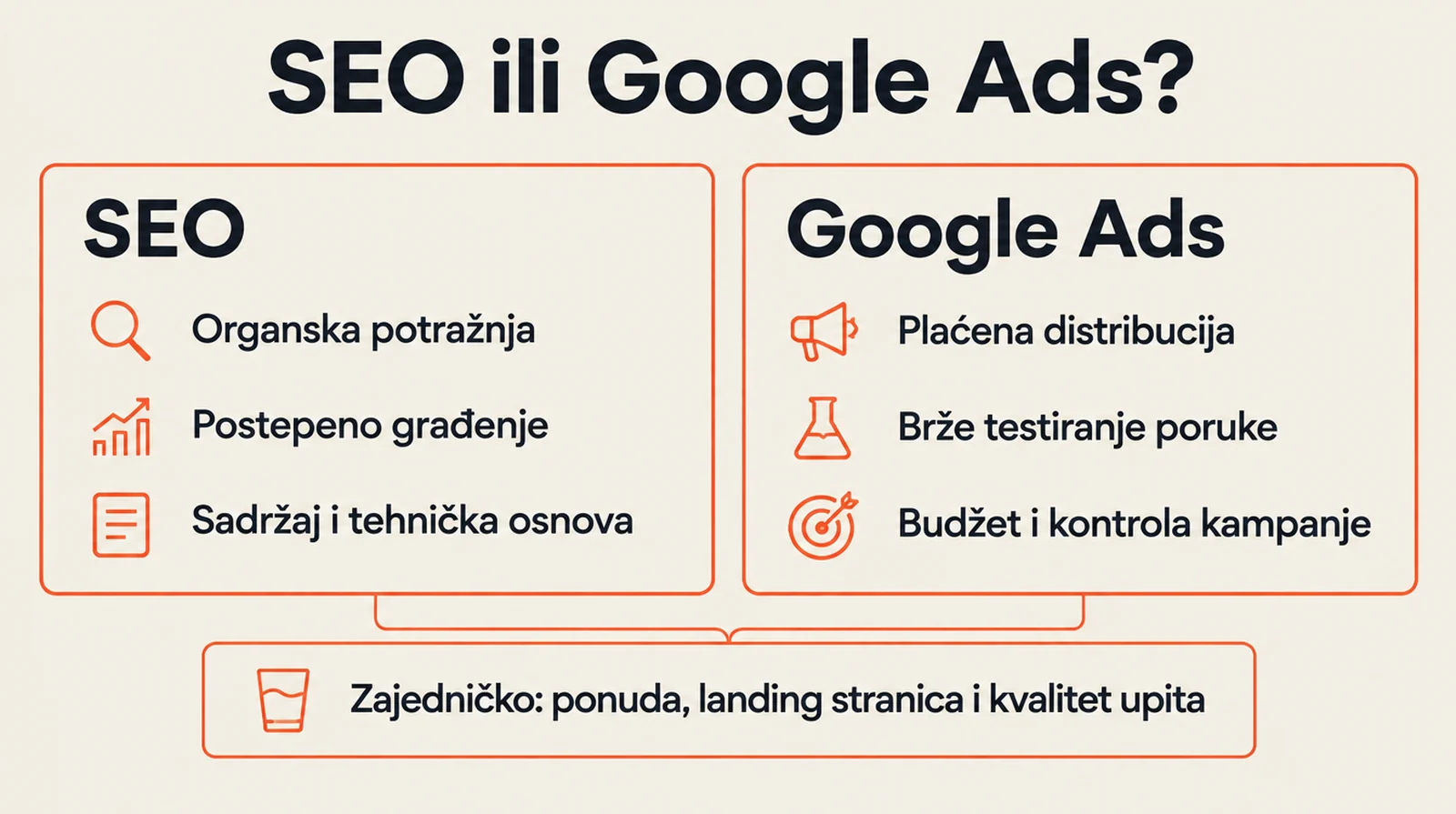
Text description of the graphic
- SEO: organic demand, gradual development, content and technical foundations.
- Google Ads: paid distribution, faster message testing, budget and campaign control.
- Shared: offer, landing page and enquiry quality.
When would I consider Google Ads first?
When a company has a clear offer, an available service and a need to test market response quickly, I would consider a limited campaign test. Before launch, I would define relevant enquiries, covered locations and when we have enough data for the next decision.
For example, a seasonal training programme with a fixed start date depends on timing and filled places. An illustrative ad could lead to a page explaining who the programme suits, dates, terms and how to apply. This does not promise a full class: we assess the decision through actual enquiries.
The landing page and contact handling must be ready. Buying more clicks for an unclear offer can accelerate spending without explaining why people leave.
I would separate media spend from management fees, content production and development. The Google Ads guide explores campaigns more broadly; here, the focus is choosing the first channel.
When would I prioritise SEO?
If the company already has relevant pages, identifiable demand and capacity to improve content continuously, SEO may be a good priority. I would particularly examine pages already getting impressions for valuable queries but explaining the offer poorly or facing technical obstacles.
For a complex B2B service, buyers may research repeatedly before a conversation. Guides to terms, approaches and implementation can support that decision. My plan would connect them to the relevant service page and a clear invitation to consult.
SEO is not free because organic clicks do not incur a platform fee. It needs work, maintenance and time to assess changes. I would evaluate scope within the same business framework as advertising, while allowing for different speed and attribution reliability. More in the SEO pricing guide.
The calculation I would make before a larger investment
Define the maximum acceptable customer acquisition cost, then connect it to the rate at which qualified enquiries become sales. Use contribution after direct costs, not just invoice value. If data is missing, first collect it through a limited test with agreed stop conditions.
Illustrative calculation: €300 acceptable cost per new customer × 20% of qualified enquiries becoming customers = €60 acceptable total cost per qualified enquiry. Include relevant channel costs, not just clicks. These figures illustrate the formula and are not a forecast.
If ads report 30 conversions, check what was counted. A phone-number click, submitted form and confirmed conversation carry different weight. Duplicates and irrelevant requests can distort profitability. The same principle applies to organic contacts.
Analytics and attribution build this connection. Alongside automated data, I would keep a simple sales question: what did the person want, and what happened?
When does combining channels make sense?
I would combine them when each has a clear role. An ad can test a specific offer while SEO content explains questions preceding purchase. Conversations and campaign findings can inform topics; a strong organic page can underpin a campaign landing page.
I would not automatically credit the same improvement to both. If we increased budget, changed the offer and published new pages simultaneously, record all three. Otherwise, it is easy to misidentify the helpful change.
Where do GEO and AEO fit?
Buyers may research through AI answers too. I would make important comparisons, terms and company information clear and verifiable, then check how the brand appears for selected questions. That connects to GEO and AI visibility.
I would not introduce a third budget just because a new acronym exists. First establish which tasks overlap with existing content and SEO foundations and which genuinely need further analysis. See the guide to SEO, AEO and GEO.
Questions before choosing a channel
Does Google Ads improve organic rankings?
It does not buy an organic position. Google explicitly distinguishes this in its SEO documentation. Campaign data can inform better decisions, but ad spending is not an organic ranking signal being sold to you.
What if the budget cannot cover both?
Choose one service, one audience and one measurable goal. Resolve the offer or website obstacle first, then undertake a limited scope you can implement and assess consistently.
Should ads stop as soon as SEO brings enquiries?
Decide from the campaign's additional value, costs and sales capacity. Organic growth alone does not tell you whether advertising still brings useful new contacts.